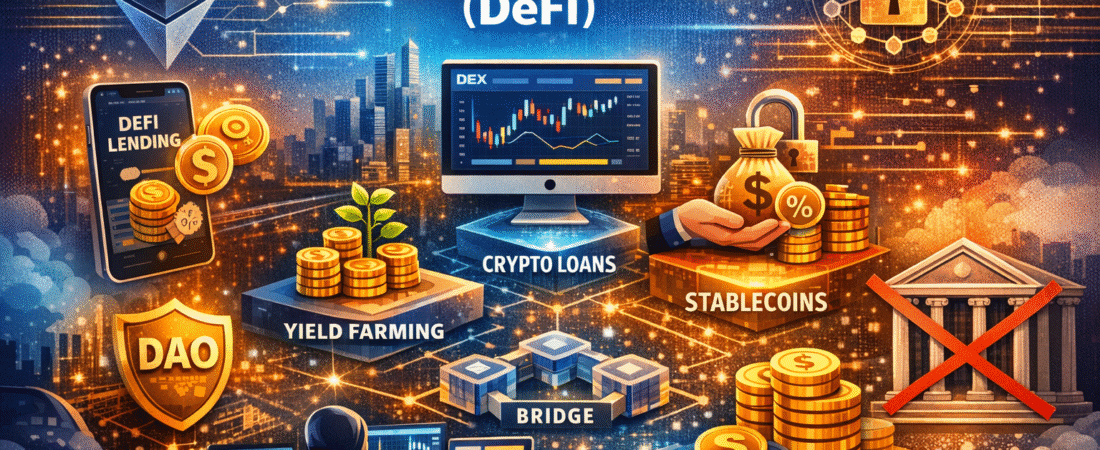
Cryptocurrency is no longer just about buying Bitcoin and hoping the price goes up. Over the last few years, a powerful movement has emerged within the blockchain ecosystem—Decentralized Finance, commonly known as DeFi. This rapidly growing sector aims to recreate and improve traditional financial systems using blockchain technology, smart contracts, and open protocols. In this in-depth guide, we will explore what DeFi really is, how it works, its core components, risks, benefits, and what the future may hold. Whether you’re a beginner or someone already active in crypto, this article will help you understand the The Future of Decentralized Finance (DeFi) where decentralized finance is heading and how to approach it strategically.
What Is Decentralized Finance (DeFi)?
Decentralized Finance refers to a blockchain-based financial system that operates without centralized intermediaries such as banks, brokers, or payment processors. Instead of relying on institutions, DeFi uses smart contracts—self-executing programs deployed on blockchain networks.
Most DeFi applications are built on the Ethereum blockchain, but other networks like Binance Smart Chain, Solana, and Avalanche also support DeFi ecosystems.
In traditional finance:
-
Banks hold your money.
-
Governments regulate transactions.
-
Financial institutions control access.
In DeFi:
-
You control your assets.
-
Smart contracts manage transactions.
-
Anyone with internet access can participate.
This shift represents a fundamental change in how financial services can be delivered globally.
How DeFi Works: The Technology Behind It
To understand DeFi, we must look at its foundation: blockchain and smart contracts.
Blockchain Infrastructure
A blockchain is a decentralized digital ledger that records transactions securely and transparently. Once a transaction is confirmed, it cannot easily be altered. This ensures trust without needing a central authority.
Smart Contracts
Smart contracts are automated programs that execute predefined conditions. For example:
-
If User A sends collateral,
-
Then User B receives a loan.
These contracts eliminate the need for banks or intermediaries.
Core Components of the DeFi Ecosystem
DeFi is not a single application. It consists of multiple financial tools and services.
1. Decentralized Exchanges (DEXs)
Decentralized exchanges allow users to trade cryptocurrencies directly from their wallets without relying on centralized exchanges.
Unlike traditional exchanges:
-
No account approval is needed.
-
No centralized custody of funds.
-
Greater privacy.
Examples include platforms that use automated market maker (AMM) models instead of traditional order books.
2. Lending and Borrowing Protocols
DeFi enables users to lend their crypto assets and earn interest or borrow assets by providing collateral.
How it works:
-
You deposit crypto into a lending pool.
-
Borrowers take loans against collateral.
-
Interest is distributed automatically.
These systems operate 24/7 without credit checks or paperwork.
3. Stablecoins
Stablecoins are cryptocurrencies pegged to stable assets like the US dollar.
They serve as:
-
A hedge against volatility.
-
A medium of exchange in DeFi.
-
A store of value within the ecosystem.
Some stablecoins are backed by fiat reserves, while others are algorithmically managed.
4. Yield Farming and Liquidity Mining
Yield farming involves providing liquidity to DeFi protocols in exchange for rewards.
Liquidity providers:
-
Deposit tokens into pools.
-
Earn transaction fees.
-
Receive additional token incentives.
However, returns can fluctuate significantly and carry risks.
5. Decentralized Autonomous Organizations (DAOs)
DAOs are governance systems where token holders vote on protocol decisions.
This allows:
-
Community-driven upgrades.
-
Transparent decision-making.
-
Decentralized management.
Advantages of DeFi
DeFi offers several compelling benefits over traditional finance.
Financial Inclusion
Anyone with internet access can participate. There are no geographical restrictions or banking barriers.
Transparency
All transactions are publicly recorded on the blockchain.
Control Over Assets
Users retain custody of their private keys and funds.
Programmability
Financial services can be automated and customized.
Innovation Speed
Open-source protocols allow rapid experimentation and development.
Risks and Challenges in DeFi
Despite its promise, DeFi carries significant risks.
Smart Contract Vulnerabilities
Coding errors can lead to hacks and loss of funds.
Market Volatility
Crypto assets are highly volatile, impacting collateral values and liquidation risks.
Regulatory Uncertainty
Governments worldwide are still developing crypto regulations.
Rug Pulls and Scams
New projects sometimes disappear after raising funds, causing investor losses.
Liquidity Risks
Some platforms may suffer from insufficient liquidity during market stress.
Understanding these risks is essential before investing.
DeFi vs Traditional Finance: A Direct Comparison
| Feature | Traditional Finance | DeFi |
|---|---|---|
| Control | Banks control funds | Users control funds |
| Access | Requires approval | Open access |
| Operating Hours | Limited | 24/7 |
| Transparency | Limited | Fully transparent |
| Speed | Slower settlements | Near-instant |
DeFi aims to complement or disrupt traditional finance by removing friction and increasing accessibility.
The Role of Layer 2 and Scalability Solutions
High gas fees and slow transaction speeds have been major limitations for DeFi.
Layer 2 solutions aim to:
-
Reduce transaction costs.
-
Increase throughput.
-
Improve user experience.
Rollups and sidechains are increasingly integrated into DeFi platforms to improve scalability.
Institutional Adoption of DeFi
Institutional interest in DeFi is growing steadily.
Large investors are exploring:
-
On-chain lending.
-
Tokenized assets.
-
Blockchain-based settlement systems.
As infrastructure improves and regulatory clarity increases, institutional participation may accelerate.
Security Best Practices for DeFi Users
If you plan to use DeFi, consider these safety measures:
-
Use hardware wallets.
-
Avoid clicking suspicious links.
-
Verify smart contract audits.
-
Never share private keys.
-
Start with small amounts.
Due diligence is critical in a decentralized environment.
The Future of DeFi: What’s Next?
The next evolution of DeFi may include:
Real-World Asset Tokenization
Assets like real estate, stocks, and bonds could be tokenized and traded on blockchain networks.
Cross-Chain Interoperability
Protocols that allow assets to move seamlessly between blockchains.
Decentralized Identity Systems
Self-sovereign identity may integrate with DeFi to enable secure reputation-based lending.
Improved User Experience
Simpler interfaces will help mainstream adoption.
Is DeFi a Bubble or a Revolution?
Skeptics argue that DeFi resembles previous financial bubbles. Supporters believe it represents a structural transformation of global finance.
The reality likely lies in between.
While speculation and hype exist, the underlying technology has introduced new possibilities for financial access, automation, and transparency.
Like the early internet, many projects may fail—but the foundational innovation may endure.
Final Thoughts
Decentralized Finance is still in its early stages, but its potential impact is enormous. By removing intermediaries and enabling programmable financial systems, DeFi opens the door to a more accessible and transparent financial world.
However, it is not without risks. Smart contract vulnerabilities, scams, regulatory uncertainty, and volatility remain serious concerns.
If you are considering entering the DeFi ecosystem:
-
Educate yourself thoroughly.
-
Manage risk carefully.
-
Avoid guaranteed-return promises.
-
Never invest more than you can afford to lose.
The future of finance may very well be decentralized—but it will require informed participants to shape it responsibly.