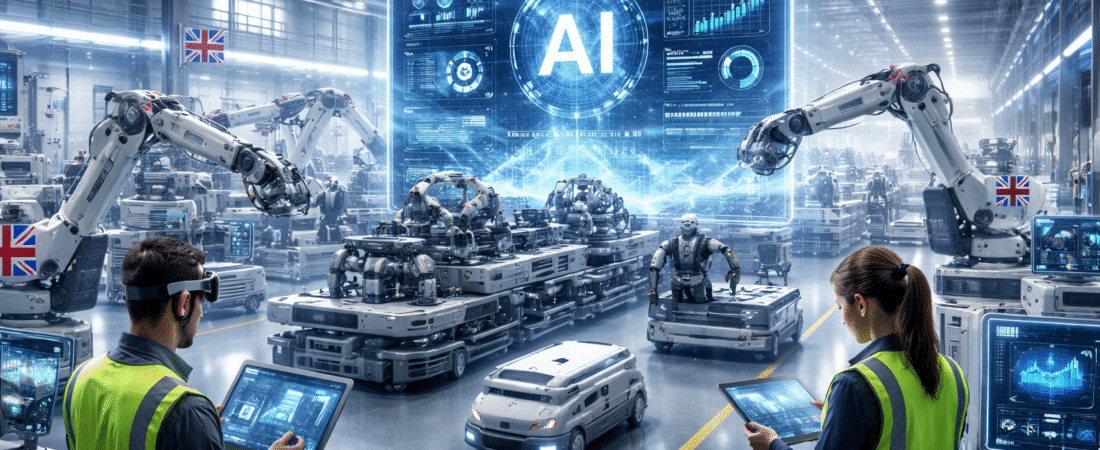
Artificial Intelligence (AI) is rapidly transforming the UK manufacturing sector in 2026. From predictive maintenance and robotics to supply chain optimization and digital twins, AI is no longer experimental—it is becoming the backbone of modern industrial production. UK manufacturers are increasingly adopting AI to improve efficiency, reduce costs, strengthen resilience, and compete globally in an Industry 4.0 economy. This article explores the role of AI in UK manufacturing in 2026, key applications, benefits, challenges, and what the future holds for smart factories across Britain.
The State of AI in UK Manufacturing in 2026
The UK is emerging as a European leader in industrial AI adoption. Recent industry research shows that more than half of UK manufacturers have already implemented AI or machine learning systems on the factory floor, with nearly all others planning adoption.
AI is no longer confined to pilot projects. Instead, it is becoming integrated into core operations such as:
- Production line automation
- Predictive maintenance systems
- Supply chain forecasting
- Quality control and inspection
- Energy optimization
However, adoption is uneven. Many manufacturers are still transitioning from experimental use to full-scale deployment, with challenges around integration, skills, and ROI.
Why AI Matters for UK Manufacturing in 2026
The manufacturing sector in the UK faces multiple pressures:
- Rising energy and labor costs
- Global supply chain instability
- Skills shortages in engineering and technical roles
- Pressure to decarbonize and meet net-zero targets
- Increasing global competition
AI helps address these challenges by enabling manufacturers to become more efficient, predictive, and adaptive.
In 2026, AI is not just about automation it is about intelligent decision-making across the entire production ecosystem.
Key Applications of AI in UK Manufacturing
1. Predictive Maintenance: Reducing Downtime and Costs
One of the most widely adopted AI use cases in UK factories is predictive maintenance. Instead of relying on fixed maintenance schedules or reacting to breakdowns, AI systems analyse sensor data to predict failures before they happen.
These systems monitor:
- Machine vibration
- Temperature changes
- Energy consumption
- Wear-and-tear patterns
By identifying early warning signs, manufacturers can prevent costly downtime and extend equipment lifespan. Some industrial studies suggest maintenance cost reductions of up to 40% when predictive systems are fully implemented.
This shift from reactive to predictive operations is one of the biggest efficiency gains in modern manufacturing.
2. Smart Robotics and Automation
AI-powered robotics is reshaping factory floors across the UK. Modern robots are no longer limited to repetitive tasks—they are becoming adaptive, collaborative systems.
In 2026, AI enables:
- Voice-controlled robot programming
- Adaptive motion based on real-time conditions
- Human-robot collaboration in shared environments
- Faster deployment through AI-assisted configuration
This reduces the need for highly specialized programming knowledge and accelerates automation adoption.
As a result, even mid-sized manufacturers can now implement robotic systems that were previously limited to large industrial players.
3. Quality Control and Computer Vision
AI-powered computer vision systems are revolutionizing quality assurance. Cameras combined with machine learning models can detect defects faster and more accurately than human inspectors.
These systems can:
- Identify microscopic defects in products
- Monitor assembly line consistency
- Flag anomalies in real time
- Reduce waste and rework rates
This leads to higher product quality and more consistent manufacturing output, especially in sectors like automotive, electronics, and pharmaceuticals.
4. Supply Chain Optimization
Global supply chains remain vulnerable to disruption, and UK manufacturers are using AI to improve resilience.
AI helps by:
- Forecasting demand more accurately
- Optimizing inventory levels
- Identifying supplier risks
- Reducing logistics delays
- Simulating supply chain scenarios
In 2026, AI-driven supply chain intelligence is becoming essential for competitive manufacturing, especially after years of global instability.
5. Digital Twins and Simulation
Digital twin technology is becoming a core part of smart manufacturing systems in the UK.
A digital twin is a virtual replica of a physical factory or machine that updates in real time using sensor data. AI uses these models to:
- Simulate production changes
- Test efficiency improvements
- Predict system failures
- Optimize workflows before implementation
This reduces risk and allows manufacturers to experiment without disrupting real-world operations.
6. Energy Efficiency and Sustainability
Sustainability is a major priority for UK manufacturing in 2026. AI is playing a key role in reducing environmental impact by:
- Optimizing energy consumption in factories
- Reducing material waste
- Improving production scheduling efficiency
- Supporting carbon reporting and compliance
Many companies are now using AI to align manufacturing operations with net-zero targets and ESG requirements.
7. Workforce Augmentation and Skills Transformation
Contrary to fears of job replacement, AI is increasingly being used to augment human workers rather than replace them.
AI supports workers by:
- Providing real-time maintenance guidance
- Enhancing decision-making with data insights
- Automating repetitive administrative tasks
- Assisting training through simulation systems
UK government research shows that AI adoption is reshaping job roles and increasing demand for digital and technical skills across industries.
The workforce of 2026 is becoming more hybrid—combining human expertise with AI-driven intelligence.
Benefits of AI in UK Manufacturing
The growing adoption of AI brings significant advantages:
1. Increased Productivity
AI improves efficiency by reducing downtime and optimising production processes.
2. Cost Reduction
Predictive systems and automation lower maintenance, labour, and operational costs.
3. Higher Product Quality
Computer vision and real-time monitoring reduce defects and waste.
4. Faster Decision-Making
AI provides real-time insights that support faster and more accurate decisions.
5. Improved Competitiveness
UK manufacturers can compete globally by adopting advanced smart factory technologies.
Challenges Facing AI Adoption in UK Manufacturing
Despite strong growth, several barriers remain:
1. High Implementation Costs
AI systems require investment in hardware, software, and infrastructure.
2. Skills Shortages
There is a lack of skilled AI engineers and data specialists in manufacturing environments.
3. Data Integration Issues
Many factories still operate legacy systems that are difficult to integrate with modern AI tools.
4. Uncertain ROI
Many companies struggle to measure the financial return of AI adoption effectively.
5. Cybersecurity Risks
Increased connectivity creates vulnerabilities in industrial systems.
The Future of AI in UK Manufacturing (2026 and Beyond)
The next phase of AI in manufacturing will focus on deeper integration and autonomy.
Key future trends include:
- Fully autonomous smart factories
- AI-driven supply chains with minimal human intervention
- Expansion of industrial “agentic AI” systems
- Wider adoption of domain-specific industrial AI models
- Greater use of robotics in logistics and assembly
Experts predict that AI will evolve from a tool into core industrial infrastructure, embedded into every stage of production.
Additionally, governments and industry bodies are investing in robotics hubs, regulatory frameworks, and workforce training programs to accelerate adoption.
Conclusion
AI is fundamentally reshaping UK manufacturing in 2026. It is driving a shift from traditional production systems to intelligent, data-driven, and highly automated smart factories.
From predictive maintenance and robotics to sustainability and supply chain optimisation, AI is becoming central to industrial competitiveness.
While challenges such as skills shortages and integration complexity remain, the long-term trajectory is clear: AI will define the future of manufacturing in the UK.
Manufacturers that invest early in AI technologies, workforce training, and digital infrastructure will be best positioned to lead in the next industrial era.