Search the phrase accountant vs bookkeeper and you will see a flood of opinions, jargon, and confusing charts. If you are like most small business owners, you are just trying to figure out who you actually need. You want to know what each person really does and how much of this you can stop doing yourself.
You might be hoping one hire can do it all. However, the real win often comes from using both an accountant and a bookkeeper in smart, different ways. The trick is understanding the accountant vs bookkeeper split so your money is handled properly without wasting time or cash.
You need to know how these roles support your core business activities. Getting this right means you can stop worrying about your financial health and focus on growth. Let’s look at how to build the right team for your needs.
Why this accountant vs bookkeeper question matters so much
If you are doing everything yourself right now, you probably feel the pressure. You likely spend late nights chasing receipts or maintaining accurate financial data. You might find yourself guessing your tax bill or worrying about tax season.
That slow dread when you log in to your bank account is a common feeling. On top of that, software ads make it seem like you can just press a few buttons and skip the pros. The truth is that while cloud tools are amazing, they are not magic.
You still need humans who know what they are doing to oversee your financial records. We will break this down in real terms without textbook language. You will see who does what and how to put the right combo in place.
What does an accountant actually do?
An accounting firm like JW Smeaton focuses on the higher level money picture in your business. Think about long-term business decisions, structure, and taxes rather than chasing invoices every week. Their main goal is to keep you legal, efficient, and moving in the right direction.
A good accountant will ask you what you want from the business, not just what your numbers say today. They use the information prepared during the year to offer high-level financial advice. This guidance helps you make strategic decisions for the future.
Key jobs an accountant usually handles
- Tax planning and tax returns means they prepare and file your income tax returns while helping plan so you do not pay more than you should.
- Business structure advice helps you decide whether you should be a sole proprietorship, corporation, or LLC and explains how that affects tax and risk.
- Reviewing financial statements involves looking at profit and loss, balance sheets, and cash flow to show what is really going on in your business.
- Forecasting and budgeting allows them to help you set up projections and targets so you can grow without guesswork.
- Advice on bigger money moves includes buying equipment, hiring more staff, expanding, or taking on debt.
If you have ever compared accountant vs software, you may have seen pieces like the accountant vs article from Global Gate Taxes. They ask if a tax advisor is worth it over a simple tool. Often the answer comes down to interpretation.
Software fills in forms based on inputs. An accountant interprets your situation to find opportunities you might miss. That difference matters when you want to improve profitability.
What accountants usually do not do
- Accountants do not want to spend their time fixing messy daily records.
- That is not a good use of their skill or your money.
- Most will not chase unpaid invoices, key in your bills every day, or process weekly payroll.
- They might help set systems up, but they will not sit inside them every day.
This is where a bookkeeper steps in and changes everything. They handle the tasks that keep the engine running smoothly.
So what does a bookkeeper actually do?
A bookkeeper sits much closer to the daily life of your business. If money goes in or out, they probably touch it in some way. Think of your bookkeeper as the person who keeps your financial house tidy.
This allows your accountant to walk in, see everything clearly, and give you strong advice based on clean data. A professional bookkeeper manages the day-to-day financial pulse of your company. They track every penny to keep your records accurate.
Core bookkeeper tasks you feel day to day
- Recording every transaction involves sales, refunds, bills, fees, wages, and more getting recorded accurately inside tools like QuickBooks or Xero.
- Bank reconciliation requires them to match your bank feed to your accounting records every month so nothing goes missing.
- Accounts receivable helps you send invoices on time and keep an eye on overdue ones so cash does not get stuck.
- Accounts payable allows them to keep track of what you owe so you pay on time without nasty late fees.
- Payroll tasks mean they calculate pay, leave, and deductions while verifying people are paid the right amount on the right day.
- Sales tax returns involve gathering and submitting the numbers your accountant and the IRS need at regular intervals.
- Regular reports give you short, clear snapshots of how you are tracking each month so you do not wait for year end to find out.
This steady flow management of accurate, up to date information is pure gold for decision making. You stop guessing because you can actually see how the business is performing week to week. Bookkeepers provide the clarity you need to operate confidently.
Accountant vs bookkeeper: side by side comparison
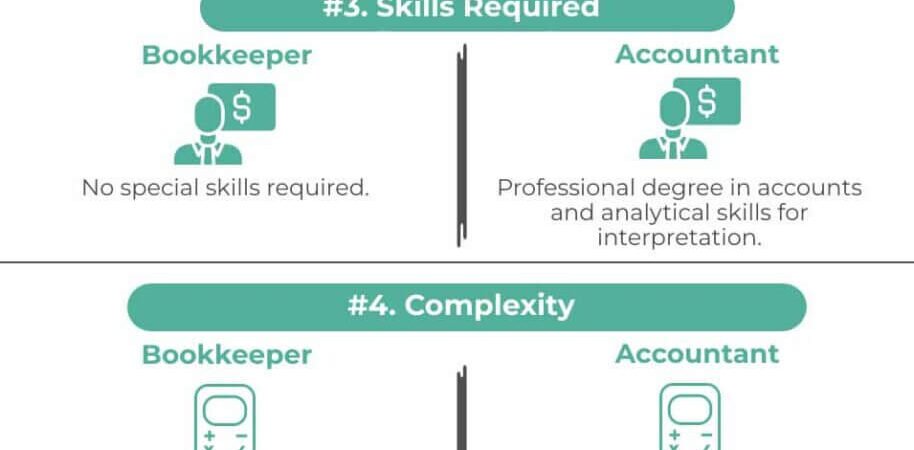
It helps to see the accountant vs bookkeeper difference laid out in one place. This table breaks down the big contrasts for easy digestion. It highlights how bookkeepers handle the groundwork while accountants manage the analysis.
| Area | Bookkeeper | Accountant |
| Main focus | Daily financial tasks and cash flow | Big picture planning, tax, and strategy |
| Typical work | Data entry, reconciliations, invoicing, bills, payroll | Tax returns, structure advice, forecasting, review of results |
| Frequency | Weekly or monthly, sometimes even daily | Quarterly or annually, plus key planning sessions |
| Data vs advice | Produces accurate financial data | Uses that data to give advice and direction |
| Common tools | Cloud accounting platforms, payroll software | Tax software, analysis tools, and financial reports |
Seeing the differences like this often flips a mental switch for owners. You stop asking which one you should hire. You start asking how you can pair them up well.
Why using both pays off in real life
You do not need to guess on this. Owners who use a good bookkeeper and a good accountant side by side usually see a few clear gains. First, they get their time back.
Every hour you are not stuck wrestling spreadsheets can go back into sales, service, and growth. This allows you to focus on your core business rather than administration. Second, they make fewer money mistakes.
Sloppy records lead to overpaying tax or missing things you were entitled to claim. Clean records lower that risk and prevent costly financial errors. Accurate records also protect you during an audit.
Cleaner books make your accountant cheaper and better
There is also a money angle people forget. Accountants often charge more per hour than bookkeepers. If your books are a mess, your accountant will spend time sorting them before they can even begin the tax work.
A bookkeeper who keeps everything tidy cuts that time sharply. That means lower accountant fees and better quality advice. Your accountant can spend more time on planning instead of fixing.
This is exactly why so many accounting firms quietly tell their clients to bring in a proper bookkeeper once they hit a certain size. It simply works better for everyone involved. Bookkeeping services act as the first line of defense against chaos.
Do small businesses really need both?
You might be thinking your business is still tiny. You may wonder if you can just hire one person or do it myself for now. That is a fair question for those in the early stages.
In the beginning, some owners do their own bookkeeping tasks with basic software and bring in an accountant once a year for taxes. The problem comes when sales pick up. The volume of transactions increases rapidly.
Soon you are trying to juggle payroll, supplier bills, and chasing invoices while also growing the company. That is usually where stress starts climbing and errors creep in. You might miss important financial transactions.
When to bring in a bookkeeper first
For many businesses, the first money pro they bring in is a part time or freelance bookkeeper. They are closer to the ground and often cost less per month than an accountant. This helps you manage cash flow management without a massive expense.
You can ask them to focus on just a few core jobs at first. Maybe managing invoices and bank reconciliation is enough to start. Then you can grow the list as you get more revenue coming in.
The important thing is that someone who knows what they are doing is keeping your numbers current. That makes it far easier for your accountant to step in when tax and planning season rolls around. It also helps you making tax compliance less painful.
Qualifications and certifications
Understanding the credentials can help you choose the right person. An accountant often holds a CPA (Certified Public Accountant) license. This requires rigorous testing and ongoing education.
They are experts in tax laws and financial compliance. A bookkeeper might be certified by organizations like the AIPB (American Institute of Professional Bookkeepers). While they do not always need a license to practice, certification shows they take their trade seriously.
Certified bookkeepers handle complex entries and understand double-entry accounting thoroughly. When you look to hire bookkeeper candidates, check for these credentials. It gives you peace of mind regarding your financial health.
Key Performance Indicators (KPIs)
One major benefit of having a finance team is tracking performance indicators. A bookkeeper records the data that feeds these metrics. An accountant helps you define which key performance indicators matter most.
These might include gross profit margin, customer acquisition cost, or inventory turnover. Tracking key performance helps you spot trends before they become problems. You can see if costs are rising faster than sales.
Without accurate data from your bookkeeper, these indicators are useless. You need precise numbers to make informed decisions. This data driven approach allows you to improve profitability over time.
What about niche accountants vs general ones
Another twist in the accountant vs conversation is the type of accountant you choose. Some work with every type of client. Others go deep on certain fields such as ecommerce.
If your business has a very specific model like selling on Shopify or Amazon, you may find specific advice helpful. For example, the accountant vs piece from Ecommerce Fastlane breaks this down well. They look at general accountant vs ecommerce accountant and explain who suits what type of business.
Even then, the bookkeeper does not go away. In many online stores, the bookkeeper tracks stock costs, fees from each channel, and regular payouts. This lets the accountant see true profit and not just raw sales.
How accountants and bookkeepers work together
Here is a simple way to picture it. The bookkeeper builds and maintains the financial engine. The accountant drives the strategy based on how that engine is running.
A strong setup has them sharing information all year. They should not just throw data over the fence at tax time. Many bookkeepers will send monthly or quarterly income statements straight to the accountant.
Your role as the owner is to stay looped in. You should ask questions and use the numbers to guide real decisions. This is better than guessing from your gut alone.
What great collaboration can look like
- Your bookkeeper keeps your accounting software current and reconciled every month.
- They send short reports showing sales, key costs, and cash balance so you can track income.
- Your accountant reviews this a few times a year and calls out risk and opportunity they see in the numbers.
- You sit down once or twice a year with both to talk about goals and map a simple plan.
This loop does not have to be fancy. It just has to be consistent. That steady rhythm helps your business feel less like chaos and more like something you are driving with intent.
How to choose a good bookkeeper
Once you are clear on the accountant vs bookkeeper difference, the next question is obvious. How do you find someone you can trust with this much financial access? You need reliability.
You want someone who is not only good with numbers but also serious about ethics. Staying up to date with rules is critical. That is where a professional group matters.
Bookkeepers who belong to respected associations have to follow a clear code of conduct. They must keep learning to maintain their status. This dedication helps bookkeepers maintain high standards for your records.
Signs you are talking to a solid bookkeeper
- They can explain what they do in plain language you actually understand.
- They have clear pricing so you know what you are paying for each month.
- They are happy to work with your existing accountant rather than replace them.
- They talk about how they protect your data and keep things confidential.
- They show how they keep skills fresh through ongoing training or membership in a strong body.
Most professional associations also keep a public directory you can search by area or skill. Those listings help you filter for people who already meet a base standard. This saves you from starting from zero.
Common questions about financial roles
Can I just use software instead of a bookkeeper?
Software is a tool, not a replacement. You still need someone to categorize expenses correctly and reconcile accounts. If you’re unsure how to handle complex transactions, software cannot save you from mistakes.
Does a bookkeeper file taxes?
Typically, no. While some professional bookkeeping services offer tax preparation, it is usually the accountant who files taxes. The bookkeeper prepares the financial data that the accountant uses for the return.
How much time business owners save by outsourcing?
It can be substantial. Owners often spend 5 to 10 hours a month on books if they do it themselves. Outsourcing this saves time that can be used for sales or strategy.
Practical steps to set up your own finance team
If this all feels helpful but a bit overwhelming, break it down into simple moves. You do not have to fix everything at once. Small steps lead to big improvements.
First, write down what money jobs are stealing the most of your time each week. Is it invoicing or bank matching? Maybe it is payroll or tax fear.
Then look at which of those belong with a bookkeeper and which need an accountant. This assessment clarifies who to hire first.
A simple three step plan
- Start with bookkeeping help
Bring in a part time bookkeeper to clean up and then maintain your day to day records. Have them set up or refine your accounting software to capture financial transactions accurately. - Loop in your accountant early
Once your books are current, ask your accountant to review the data. Ask them to outline tax planning steps and business structure checks based on accurate financial reports. - Build a simple reporting rhythm
Agree on monthly or quarterly reports your bookkeeper sends you. Schedule a few check in calls a year with your accountant to discuss financial health.
This gives you structure without turning your business into a corporate giant. You still run lean, but you are no longer flying blind. You will be able to manage cash flow with confidence.
In Summary
The accountant vs bookkeeper debate is the wrong fight. They are different tools that shine at different parts of your financial life. One keeps every number current and correct day to day.
The other turns that pile of data into smart moves and legal, efficient tax results. When tax season arrives, you will be thankful for having both in your corner. Bookkeepers provide the foundation, while accountants provide the roof.
If you are serious about building a stable business that does not keep you up at night, treat them as a team. Get the bookkeeping help in place first. Then let your accountant do what they do best on top of that clean foundation.
The payoff is less stress and fewer nasty tax surprises. You build a business you can grow with far more confidence than guesswork ever gives you. With the right support, you can reduce stress and focus on success.