Online color prediction games have become a popular form of digital entertainment, offering players quick rounds of chance-based outcomes. The rules are simple: predict which color will appear next, place a wager, and wait for the result. While the mechanics are straightforward, the way players make decisions within these games is far more complex. Human psychology plays a significant role, and cognitive biases often influence how individuals approach predictions, interpret outcomes, and manage risks. These biases can distort rational thinking, leading players to make choices that feel logical but are actually driven by subconscious tendencies.
The Gambler’s Fallacy
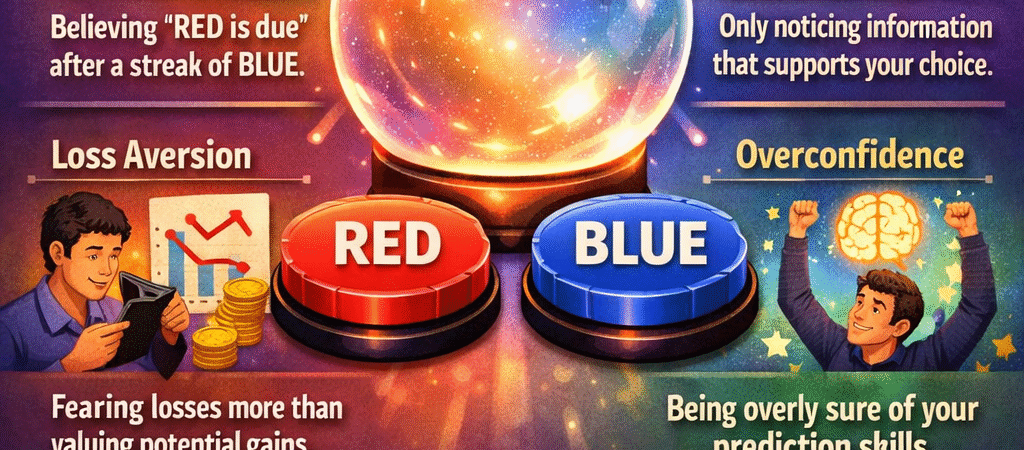
One of the most common cognitive biases in color prediction games is the gambler’s fallacy. This bias occurs when players believe that past outcomes influence future ones. For example, if red has appeared several times in a row, a player may assume that green is more likely to appear next. In reality, each round is independent, and the probability remains constant regardless of previous results. The gambler’s fallacy leads players to make predictions based on perceived patterns rather than actual probabilities, often resulting in misguided decisions and unnecessary risks.
Confirmation Bias
Confirmation bias is another powerful influence on player behavior. This bias refers to the tendency to seek out or interpret information in a way that confirms existing beliefs. A player who believes that certain colors appear more frequently may selectively remember instances that support this belief while ignoring evidence to the contrary. Over time, this reinforces the illusion of control and encourages players to stick to strategies that are not mathematically sound. In color prediction games, confirmation bias can make players overly confident in their chosen methods, even when those methods are based on flawed assumptions.
Overconfidence Bias
Overconfidence bias often emerges after a streak of wins. Players begin to believe they have developed a skill or strategy that allows them to predict outcomes more accurately than others. This inflated sense of ability leads them to wager larger amounts or take greater risks, even though the game is fundamentally based on chance. Overconfidence can create a cycle where players believe they have mastered the system, only to face losses when randomness inevitably disrupts their expectations. The bias not only affects financial decisions but also prolongs engagement by convincing players that success is within their control.
The Illusion of Control
Closely related to overconfidence is the illusion of control. This bias occurs when players believe they can influence outcomes in a game of chance. In color prediction games, the act of choosing a color may give players a false sense of agency, even though the results are determined by algorithms or random number generators. The illusion of control enhances engagement by making players feel involved, but it also contributes to risky behavior when they overestimate their influence on the game.
Loss Aversion
Loss aversion is a cognitive bias that affects how players respond to outcomes. People generally feel the pain of losses more intensely than the pleasure of equivalent gains. In color prediction games, this means that losing a wager can have a stronger emotional impact than winning the same amount. As a result, players may adopt strategies aimed at avoiding losses rather than maximizing gains. This can lead to conservative predictions or, conversely, desperate attempts to recover losses through riskier bets. Loss aversion often drives players to continue playing longer than intended, hoping to erase the negative feelings associated with losing.
Anchoring Bias
Anchoring bias occurs when players rely too heavily on initial information or experiences when making decisions. For instance, if a player’s first few rounds result in frequent wins, they may anchor their expectations to those outcomes and assume that winning is the norm. Conversely, early losses may anchor them to a belief that the game is unwinnable. Anchoring shapes future decisions by distorting perceptions of probability and influencing how players evaluate risk. In color prediction games, this bias can lead to persistent strategies that are not aligned with the actual randomness of outcomes.
Conclusion
Decision-making in online color prediction games at Daman Game Login is far from rational. Cognitive biases such as the gambler’s fallacy, confirmation bias, overconfidence, illusion of control, loss aversion, and anchoring all play significant roles in shaping player behavior. These psychological tendencies lead individuals to interpret randomness in ways that feel meaningful, even when outcomes are purely chance-based. By recognizing these biases, players can better understand their own decision-making processes and approach the games with greater awareness. Ultimately, while color prediction games are designed for entertainment, the study of cognitive biases within them reveals much about human psychology and the ways in which people interact with uncertainty.