In an industry historically defined by heavy steel, diesel exhaust, and chaotic logistics, a new standard for operational excellence is taking root. For decades, local waste management operators and dumpster rental businesses have been forced to rely on fragmented systems—whiteboards, sticky notes, and endless group texts—to manage their daily fleets. Today, that analog era is officially being pushed out by a digital platform forged directly in the trenches of a rapidly scaling hauling company. This article explore How Todd Atkinson Productized His 80-Dumpster Fleet Experience to Revolutionize Waste Management.
Todd Atkinson, founder of Pack Mule Dumpsters, built Bin Boss out of pure necessity. He needed a way to manage an 80+ dumpster fleet without drowning in paperwork, text messages, and endless spreadsheets. When the tools he tried didn’t cut it, he decided to build something better. Today, Bin Boss is the platform Todd wishes he had when he started — and it’s built to help other dumpster rental owners grow with way less stress. By productizing his own professional biography and operational blueprint, Atkinson is offering a transformative solution to the entire industry.
The Breaking Point: When Spreadsheets Fail a Growing Fleet
The story of almost every successful service business follows a dangerously predictable arc: initial hustle leads to rapid growth, and rapid growth leads to administrative collapse. Managing ten or twenty roll-off containers is entirely feasible with a notebook. But when a local hauling operation expands into a regional powerhouse, the complexity of the logistics scales exponentially.
Atkinson experienced this “complexity wall” firsthand. As Pack Mule Dumpsters expanded its footprint across Ohio, acquiring high-capacity 30-yard and 40-yard containers to service major roofing and construction contracts, the back-office operations began to crack under the weight of the company’s success. The sheer mental load of tracking which driver was assigned to which route, identifying which bins were sitting empty at a job site accruing zero revenue, and chasing down unpaid invoices became a staggering bottleneck.
The realization was clear: the barrier to taking the business to the next level was no longer a lack of physical assets or customer demand. The barrier was the complete absence of a digital nervous system capable of handling the high-velocity churn of a massive fleet.
From the Battlefield to the Landfill: A Veteran’s Approach to Logistics
What makes this technological leap unique is the architect behind it. Before managing fleets or directing software development, Atkinson served his country as a military veteran deployed to Afghanistan. In the military, logistics are not a secondary concern; they are a matter of life and death. Discipline, punctuality, and an unwavering commitment to the mission are the bedrock of success.
When Atkinson transitioned to the civilian waste sector, he immediately noticed the “wild west” mentality that plagued the industry. Drop-off times were merely suggestions, invoices were frequently misplaced, and communication with drivers was a constant game of telephone. Atkinson imported a regimented, combat-simple approach to his hauling operations. He proved that a blue-collar industry could execute with the precision of a white-glove service. This disciplined mindset didn’t just fuel Pack Mule’s explosive revenue growth; it became the foundational logic code for the software he would eventually build.
The “Operator-as-a-Service” Concept
Generic field service applications are typically built by tech developers sitting in climate-controlled offices who have never stepped foot on a muddy construction site. They create software that looks great in a boardroom but completely fails to understand the nuances of the hauling world—like the financial sting of a “dry run” fee, the necessity of tracking overweight landfill tickets, or the logistical nightmare of a bin blocked by a parked vehicle.
Atkinson flipped this dynamic by offering his own lived experience as a deployable product. By utilizing Bin Boss Software, independent haulers are essentially licensing the hard-won operational wisdom of a seven-figure business owner. Every feature, button, and automated workflow represents a real-world problem effectively solved in the field. It allows new and growing owners to completely bypass the expensive “trial and error” phase of scaling their yard. The technology acts as a digital twin of a highly successful fleet commander, absorbing the administrative shockwaves so the owner can focus entirely on high-level strategy and customer acquisition.
Eradicating the Chaos of the Dispatch Desk
The dispatch desk is the beating heart of any rental operation. It is also the epicenter of daily stress. In a manual system, a single customer calling to change a drop-off location can trigger a cascade of frantic phone calls to reroute drivers, leading to missed stops and frustrated contractors. The solution required a total overhaul of how the office communicates with the road.
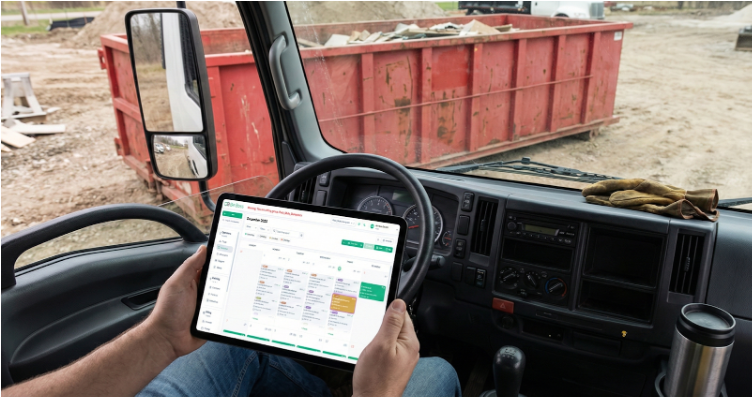
The implementation of specialized Dumpster dispatching software essentially replaces the manual transmission of a hauling business with an autonomous engine. This technology utilizes drag-and-drop scheduling, real-time GPS tracking, and instant mobile app syncing. When a dispatcher updates a route or adds a placement note, the driver receives the new parameters instantly on their phone. This seamless, frictionless connection reduces phone tag by up to eighty percent. It demands that every steel box is accounted for and every route is fully optimized, completely eradicating the guesswork from daily deployment.
Abolishing the Success Tax: Built for Scale, Not Penalties
One of the most disruptive elements of Atkinson’s productized biography is his aggressive stance against traditional pricing models. Standard tech companies often employ tiered pricing that penalizes a business for adding more trucks, more users, or more dispatchers. Atkinson views this as a “Success Tax”—a model he actively despised as a fleet operator.
Because he identifies as a hauler first and a software founder second, he structured his platform to align with the ultimate goal of his peers: aggressive, profitable scaling. Operating on a predictable, flat-rate structure, the system encourages operators to buy fifty more trucks and hire ten more employees without the fear of a skyrocketing monthly software bill. This pricing philosophy is a direct reflection of a founder looking out for the operational health of the independent hauling community, prioritizing long-term industry growth over short-term corporate greed.
Conclusion: A Blueprint for the Future of Hauling
The transition from whiteboards to integrated digital intelligence is no longer just a luxury for the massive national conglomerates; it is the new baseline for survival in the modern dumpster rental market. Todd Atkinson’s journey from a frustrated fleet owner to an industry innovator proves that the most powerful solutions are always forged in the field.
By packaging his regimented discipline, his operational battle scars, and his massive scaling success into a single, accessible platform, Atkinson has provided independent haulers with a clear roadmap to the future. Dumpster rental operators no longer have to choose between growing their revenue and keeping their sanity. By embracing this battle-tested technology, owners can finally abandon the chaos of manual management, reclaim their weekends, and build a lasting, highly profitable legacy with absolute confidence.