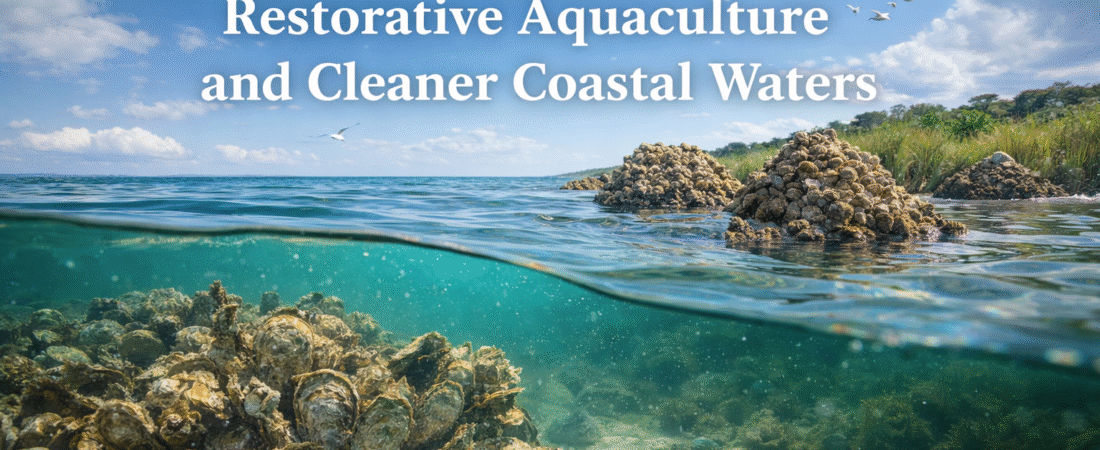
On a low tide morning, oyster farming can look like quaint rows of bags and cages, a skiff idling in the shallows, the steady choreography of sorting and tumbling shellfish that will eventually end up on ice at a raw bar. But the real story is underwater, where oysters do what they’ve always done: pump water across their gills, pull out microscopic food, and in the process change the chemistry and clarity of the places we ask coasts to be both productive and resilient. Here is the article about Oysters As Climate Helpers: Restorative Aquaculture and Cleaner Coastal Waters.
NOAA Fisheries puts it plainly: under certain conditions, a single oyster can filter up to 50 gallons of water per day, and cleaner water can help underwater grasses rebound habitat that, like oyster reefs themselves, stabilizes the bottom and supports juvenile marine life. In a warming world where coastal communities are squeezed by storms, sea-level rise, and nutrient pollution, that “simple” filtration starts to look like climate adaptation delivered one bivalve at a time.
The Comeback Story That Still Isn’t Finished
The reason oysters are being talked about as ecosystem helpers is also the reason they’re farmed so intensively now: we broke a lot of reefs. NOAA notes oyster populations in many areas are at historic lows, hammered by development-driven erosion, wetland loss, nutrient pollution, disease, habitat loss, and overharvesting. In the Chesapeake Bay, ground zero for modern oyster restoration, NOAA says oyster populations are only about 1–2% of historical levels.
The Nature Conservancy goes even broader: it estimates about 85% of native oyster reefs have disappeared globally, a staggering figure that helps explain why restoration groups talk about oysters the way foresters talk about trees.
And yet, oysters persist because reefs can be rebuilt, and because aquaculture can take pressure off wild harvest while also creating “living infrastructure” in the water. NOAA points out that farmed oysters, clams, and mussels account for about two-thirds of total U.S. marine aquaculture production. The farmed shellfish boom isn’t just a food trend; it’s a structural shift in how the U.S. produces coastal protein.
Where Pacific Seafood Fits Into the Restorative Aquaculture Conversation
Pacific Seafood is a useful case study because it’s big enough to make systems visible. In its 2024 Corporate Social Responsibility (CSR) report, the company describes a footprint of 40+ facilities and 3,000+ team members, selling products “throughout the world.” That scale can cut two ways in sustainability stories: more capacity can mean more impact, but it can also mean more resources for monitoring, certification, and consistent controls.
On the oyster side, Pacific makes a very specific claim in its CSR report: it is the first and only company certified to offer 4-Star Best Aquaculture Practices (BAP) oysters (2018) (and 4-Star BAP steelhead in 2021). BAP’s structure matters here because it doesn’t treat “responsible aquaculture” as a vibe; it outlines standards across the production chain hatchery to processing, so operators have to show their work.
Pacific also reports that it offers 73 certified sustainable fish species across programs, including MSC, RFM, ASC, and BAP, an indicator of how central third-party verification has become to the company’s growth pitch.
Why Oysters Help Water Quality (And What “Help” Really Means)
Oysters don’t “clean” a bay in the way a wastewater treatment plant does. Their superpower is filtration: they remove algae and suspended particles as they feed. NOAA describes oysters as a natural filter that can improve waters overloaded with nutrients, and ties the benefits to knock-on effects like clearer water and healthier underwater grasses.
That matters for climate resilience because coastal degradation is often a feedback loop: nutrient pollution fuels algae; algae and turbidity block light; underwater grasses weaken; sediment resuspends more easily; shorelines erode faster; habitats unravel. Oysters don’t solve every step, but they can slow the loop down.
They also build structure. NOAA emphasizes that oyster reefs “fuse together” into a rock-like habitat for hundreds of species, providing shelter, food webs, and nurseries for commercially valuable fish and invertebrates. In some locations, NOAA adds, reefs can reduce wave energy and help prevent erosion, functioning as buffers against storms and tides. That’s a climate story even when nobody says the word “carbon.”
The Less-Romantic Part: Restorative Aquaculture Is Also Risk Management
If oysters are ecosystem helpers, oyster farming is ecosystem management, especially because shellfish are living animals grown in open water.
Biosecurity isn’t optional. Disease pressure is one of the reasons NOAA lists oyster populations as historically diminished, and modern growers have to assume pathogens will always be part of the landscape. Then there’s food safety risk, including Vibrio bacteria that can proliferate when harvested shellstock stays warm.
The U.S. regulatory backbone for that problem is the FDA-recognized National Shellfish Sanitation Program (NSSP). In its 2023 revision, the NSSP model ordinance sets hard temperature-and-time guardrails: shellstock should be iced or stored at 45°F (7.2°C) or less, and it should not remain without ice or refrigeration for more than two hours at processing or transfer points like loading docks. The same NSSP section lays out critical limits around processing, such as chilling shucked meats to 45°F (7.2°C) or less within three hours of shucking when the product hasn’t been refrigerated prior, or within four hours after removal from refrigeration when it has.
Those numbers are the difference between “farm-fresh” and a preventable outbreak. They also show why oyster logistics and dock discipline are inseparable from oyster ecology: one weak link can erase the goodwill of an entire “restorative” narrative.
Monitoring the Ecosystem You’re Farming In
Even before oysters are harvested, growers have to watch the water itself, salinity swings, low oxygen events, harmful algal blooms, and contamination closures. NOAA describes its own role in restoration as deeply data-driven: mapping oyster bed conditions, monitoring water quality, and sharing findings with industry and conservation partners. And NOAA’s Restoration Center has funded more than 70 oyster restoration projects in 15 states, a reminder that “restoration” is now a national infrastructure project, not a boutique effort.
On the operator side, Pacific’s CSR report makes an argument that its monitoring culture doesn’t stop at the farm gate. It says its hatcheries and farms employ “industry best practices” to protect “clean environments” and “healthy habitats,” framing habitat care as part of production, not separate from it.
And when oysters become food, the company leans on its Value Creation & Quality (VCQ) teams: Pacific reports “persistent testing” of processing environments for pathogens such as Listeria and Salmonella, and a food safety process that includes regular environmental and pathogen testing through a robust sampling plan. At distribution sites, the CSR report quantifies oversight: a minimum of 120 frozen receiving checks annually and a minimum of 12 full product inspections annually.
For sanitation, Pacific reports a Sanitation Team of more than 130 team members following a Master Sanitation Program with up to 20 steps, including daily equipment breakdown for pathogen testing and sanitation. These aren’t oyster-specific metrics, but they’re the kinds of operational controls that determine whether shellfish aquaculture is perceived as trustworthy or just trendy.
The Balancing Act: Farms That Help Coasts Without Pretending They’re Reefs
The strongest “oysters help the climate” stories avoid magical thinking. Oyster reefs can reduce erosion and wave energy in some locations, but they’re not a universal seawall. Oysters can improve water clarity, but they can’t out-filter unchecked nutrient loads. Even The Nature Conservancy, enthusiastic about farmed shellfish supporting restoration, frames the work as both conservation and economic resilience, not a silver-bullet fix.
That’s why the most credible operators talk in verbs, not slogans: monitor, test, tag, chill, certify, audit, repair, document. Pacific’s CSR report leans hard into that language, highlighting third-party certification and systems verification (including its 4-Star BAP oyster distinction) as the scaffolding around its aquaculture claims.
The Takeaway
Oysters are climate helpers in the way wetlands are climate helpers: they’re living systems that add resilience when you give them the right conditions and when you manage the risks with discipline. NOAA’s science case for reefs is strong: filtration up to 50 gallons per oyster per day under certain conditions, habitat for hundreds of species, and coastal protection benefits in some locations. The restoration case is urgent: Chesapeake oysters are at ~1–2% of historical levels, and ~85% of native reefs are gone globally.
The aquaculture case is more nuanced and more interesting. It’s where ecology meets compliance: if you want oysters that help coasts, you also need oyster farming that respects biosecurity, monitors ecosystems, and follows the unglamorous temperature rules that keep shellfish safe.