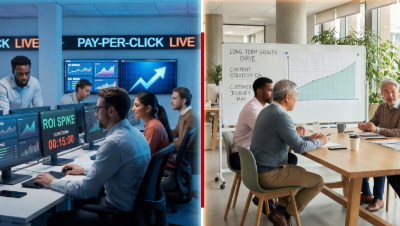
Speed is seductive in digital marketing. The promise of quick leads, instant traffic, and fast conversions is hard to ignore, especially for businesses under pressure to grow. Here is the overview of how Performance Marketing vs Sustainable Growth Marketing: What Businesses Must Understand Before Scaling.
This is why many companies searching for a Digital Marketing Agency Chennai end up prioritising performance marketing first. Paid campaigns launch quickly, dashboards light up with numbers, and results appear almost overnight.
But speed, while useful, is not the same as sustainability, and confusing the two often leads to rising costs and diminishing returns.
This is where the real conversation begins. Performance marketing and sustainable growth marketing are not opposites, but they are fundamentally different in intent, structure, and outcomes.
Businesses that understand this difference early tend to build durable growth engines. Those that don’t often find themselves locked into a cycle of increasing ad spend just to maintain the same level of results.
To make the right choice, it’s important to step back from tools and tactics and look at how each approach actually works.
What Performance Marketing Is Designed to Do
Performance marketing is built for immediacy. It focuses on paid acquisition channels, search ads, social ads, display networks, where results can be measured quickly and optimised in real time.
The appeal is obvious: campaigns can be launched within days, results are visible almost instantly, and return on ad spend can be tracked closely.
For businesses entering a new market, launching a new product, or testing demand, performance marketing plays a valuable role.
It reduces uncertainty and accelerates learning. You can see which messages resonate, which audiences convert, and which offers perform best.
However, performance marketing has a built-in limitation. It works as long as you keep paying.
The moment spend is paused, traffic stops. There is no compounding effect unless performance campaigns are supported by deeper marketing infrastructure.
This is where many businesses encounter friction, not because performance marketing fails, but because it is asked to do more than it was designed for.
Why Performance-Only Strategies Become Expensive Over Time
The hidden cost of performance marketing shows up gradually. Initial results may look strong, but over time, acquisition costs rise.
Audiences saturate. Competition increases. Marginal gains require disproportionately higher spend.
This happens because performance marketing often operates without support from organic demand capture, content authority, or conversion optimisation.
Ads are used not just to accelerate growth, but to replace foundational marketing elements that should exist independently.
Businesses exploring Digital marketing services in Chennai frequently encounter this challenge. They invest heavily in paid channels but neglect SEO, content depth, funnel optimisation, and customer lifecycle strategy.
As a result, performance campaigns end up carrying the entire growth burden, and that is neither efficient nor sustainable.
When performance marketing operates in isolation, it becomes a treadmill. You keep running just to stay in the same place.
What Sustainable Growth Marketing Actually Means
Sustainable growth marketing takes a longer view. It is designed to build assets that continue to generate value even when active spending fluctuates.
Instead of focusing solely on acquisition, it focuses on the entire customer journey, from discovery to conversion to retention.
At its core, sustainable growth marketing balances four pillars:
Organic demand capture
SEO, content, and brand authority ensure that demand is captured consistently without direct cost per click.
Paid acceleration
Performance marketing is used strategically to amplify what already works, not to compensate for what’s missing.
Funnel optimisation
Landing pages, messaging, and user journeys are continuously improved to increase conversion efficiency.
Lifecycle nurturing
Email, remarketing, and retention strategies extend customer value beyond the first transaction.
This balance is what allows growth to compound instead of reset every quarter.
Performance Marketing Wins Quarters. Growth Marketing Wins Years.
The most important difference between these two approaches lies in time horizon.
Performance marketing is excellent at winning short-term battles. It can drive leads this month, sales this quarter, and momentum for a launch. But it rarely builds lasting advantage on its own.
Sustainable growth marketing wins wars. It builds visibility that doesn’t disappear overnight, conversion systems that improve with use, and trust that reduces acquisition friction over time.
Businesses that rely exclusively on performance marketing often find themselves asking why growth feels harder each year. Businesses that invest in sustainable systems often find that growth becomes easier, cheaper, and more predictable over time.
The difference is not effort, it’s architecture.
Why the Best Strategies Combine Both Approaches
This is not an argument against performance marketing. In fact, the most successful digital strategies use performance marketing extensively, but not independently.
Performance marketing works best when it is plugged into a broader growth system. Paid campaigns become more effective when organic content builds trust.
Conversion rates improve when funnels are optimised. Customer lifetime value increases when lifecycle strategies are in place.
In this model, performance marketing accelerates growth rather than sustaining it alone.
Spend becomes more efficient because each click lands in a system designed to convert, retain, and compound value.
This is where businesses often see the biggest shift in results, not from changing channels, but from changing how channels work together.
How to Tell Which Approach Your Business Is Using
A simple way to diagnose your current strategy is to ask a few questions:
- If paid spend stopped tomorrow, would leads continue?
- Do conversion rates improve over time or stay flat?
- Is marketing knowledge accumulating or starting from scratch each quarter?
If growth collapses the moment ads pause, you are likely operating in a performance-only model.
If growth slows but doesn’t stop, you are likely building sustainable infrastructure.
Neither is inherently wrong, but only one scales gracefully.
Choosing the Right Marketing Model for Your Business Stage
Early-stage businesses often benefit from performance marketing to validate demand quickly. Mature businesses benefit more from sustainable systems that reduce reliance on paid acquisition.
The mistake many companies make is staying in performance mode long after validation is complete. What worked to start growth becomes a bottleneck as scale increases.
The right time to shift toward sustainable growth marketing is not when performance marketing stops working, but when it starts getting expensive.
Growth Is a System, Not a Channel
The future of digital marketing belongs to businesses that understand one simple truth: growth is engineered, not triggered. Channels don’t create growth, systems do.
Performance marketing is a powerful engine, but it needs a road to run on. Sustainable growth marketing builds that road, ensuring that every campaign travels further than the last.
Businesses that align both approaches thoughtfully stop chasing growth and start designing it.
For organisations looking to move from short-term wins to long-term momentum, this systems-led approach is where digital marketing evolves from expense to infrastructure, an approach exemplified by Ayatiworks.