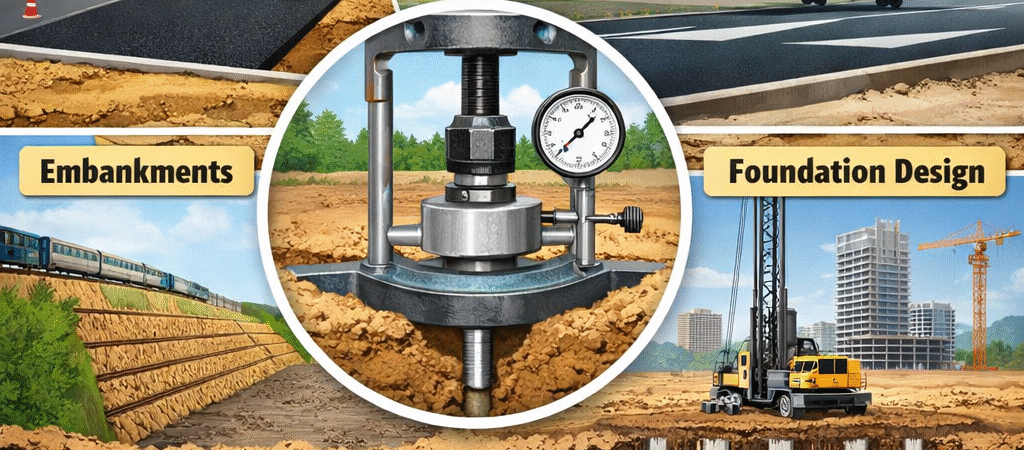
In civil engineering, experience has shown that understanding actual site conditions is essential for successful designs and construction. That’s where on-site methods like the in-situ California Bearing Ratio, commonly known as the In Situ CBR Test, become invaluable. This type of in situ testing takes the theory out of the office and brings it directly to the soil and subgrade on your project. It is a fast, accurate way to determine the CBR value that underpins designs for pavements, foundations, and roads.
Effective CBR testing on-site gives you immediate results about the mechanical strength and bearing capacity of soils in their natural state. Whether you’re planning a large highway, a retail car park, or even temporary access roads, these in-situ CBR test procedures are fundamental to safe and cost-effective construction.
Below are several real-world applications that demonstrate why in situ testing services like this are considered indispensable in construction and civil engineering.
CBR Test and Road Construction: Designing Durable Pavements
The classic application of the in-situ CBR test is in road construction and pavement design. The CBR value you get from the test tells you exactly how thick each layer needs to be, the sub-base, base, and surfacing, based on the conditions you find on-site. The softer the soil, the more robust the construction needs to be. And when you get a high CBR value, you can optimise the thickness and save on costs.
The way the test works is pretty straightforward. You use a cylindrical plunger to push a soil sample at a controlled rate and measure the resistance, that’s the CBR value. Then you compare it to standard CBR values in design manuals for roads and bridges.
Real-world impact: By testing CBR values across a route, you can do a smarter site investigation, design a more even pavement, and reduce the risk of costly repairs down the line.
Verifying Compaction and Layer Quality: In-Situ CBR Test Procedure
It’s not just the foundation that needs a little testing, by the way. Every time you add a new layer, like compacting a granular subbase, for instance, you want to check that it’s got the right bearing capacity. An in-situ CBR test can do that in a flash, giving you the confidence that your construction method and moisture content are doing the job.
If the in-situ CBR value doesn’t match your target, you can spot problems like poor compaction, the wrong particle size, or too much moisture. If you catch that sort of issue early, it can save you a whole heap of money in the long run.
Real-world impact: This test method helps you avoid costly failures by making sure each layer is up to the job.
Site Investigation for Car Parks and Hardstandings: Beyond Laboratory CBR
For car parks, industrial yards, or hardstandings, it’s the in-situ CBR test that gives you a true reading of the soil’s capacity. By testing several areas in the field, you get a clear picture of the site conditions and can be sure your pavement or surfacing isn’t overbuilt or underdesigned for the loads it’ll get.
You can use an in-situ CBR test in conjunction with other testing methods like plate bearing tests or lightweight deflectometer assessments to get a really comprehensive view of the site’s capacity.
Real-world impact: By getting the CBR values right from on-site testing, you can keep maintenance costs down and make sure users are safe.
Temporary Works and Foundation Design: In-Situ Test for Safety
When it comes to temporary structures like crane platforms or event sites, you need to understand ground strength fast. That’s why in-situ CBR testing is used to estimate the required sub-base thickness to prevent subsidence or failure. By combining CBR test results, plate bearing test data, and detailed site investigation, you can have peace of mind that temporary works will be safe under load.
Real-world effect: The in-situ test is carried out right before the works, so you get the most accurate bearing capacity of soil in its current state.
Diagnosing Pavement Failure and Planning Remediation
When road and pavement construction is showing signs of wear and tear, like cracking, rutting, or potholes, a targeted in-situ CBR test can help identify the cause. The test is performed by drilling a core into the pavement and evaluating the strength of the subgrade or sub-base beneath through proper calculations. When combined with lab CBR, particle size analysis and other site investigation methods, you can pinpoint the problem (dry, loose soil or poor compaction, for example).
Real-world effect: This scientific approach lets you design targeted, permanent solutions like subgrade stabilisation and avoid recurring surface problems.
The CBR Test’s Role in Construction and Civil Engineering
Ultimately, the in-situ CBR test is more than a procedure; it’s a vital parameter used to assess the load-bearing capacity, resilience, and long-term performance of the structures you build. It provides the basis for decisions in design method, foundation design, and even the selection of materials testing and site locations.
By using in situ and situ testing services, you ensure your road design, pavement, and foundations are matched precisely to site conditions and project requirements. When supported with additional tests, such as the plate bearing test, penetration test (with a cylindrical plunger), or you can confidently rely on CBR values to guide the safe and economical construction of roads and infrastructure.
Remember, accurate determination of the CBR value, carried out in accordance with British and European standards and supported by expert situ testing services, sets your civil engineering project on the right track from the very start.