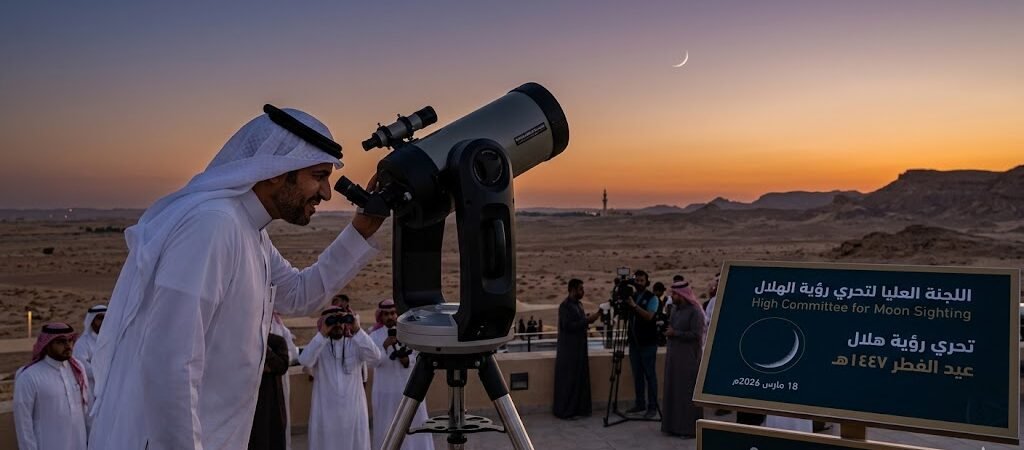
Eid ul‑Fitr marks a joyous end to the holy month of Ramadan. Central to its observance is the sighting of the new moon (Hilal), which determines the first day of Shawwal — and thus, the celebration of Eid. In Saudi Arabia, where moon‑sighting is a deeply rooted religious and cultural practice, the announcement of the Eid moon is watched keenly by millions around the world. This year, the Eid ul‑Fitr moon was sighted on 18 March, bringing anticipation and celebration across the Kingdom. In this article, Eid ul‑Fitr Moon in Saudi Arabia: A Comprehensive Guide to the 18 March Sighting.
What Is Eid ul‑Fitr and Why Does the Moon Matter?
Eid ul‑Fitr is the festival that marks the end of Ramadan, the ninth month of the Islamic lunar calendar. It is a day of prayer, feasting, charity (Zakat al‑Fitr), and community celebrations. Unlike solar calendars, the Islamic calendar depends on the lunar cycle — specifically, the sighting of the new crescent moon (Hilal).
The Lunar Calendar and Islam
The Islamic calendar consists of 12 lunar months, each lasting 29 or 30 days, depending on the moon’s visibility. Because lunar months are about 10–11 days shorter than solar months, the timing of Ramadan and Eid shifts earlier each year relative to the Gregorian calendar.
The sighting of the new moon heralds the start of a new month. For Eid ul‑Fitr, this means:
-
Ramadan ends when the new moon of Shawwal is sighted.
-
Eid begins the following day.
This method follows the tradition of Prophet Muhammad (peace be upon him), who instructed Muslims to fast when the moon is sighted and to break the fast when the next moon is sighted.
How Is the Moon Sighted in Saudi Arabia?
Saudi Arabia follows a combination of sighting reports and astronomical calculations to determine the start of Islamic months. The process involves religious authorities, astronomers, and religious committees.
The Role of the Supreme Court and Moon‑Sighting Committees
In Saudi Arabia, moon‑sighting is overseen by:
-
The Supreme Court (Al‑Mahkama al‑‘Ulya)
-
Official Local Committees
These bodies gather reports from observers across the Kingdom shortly after sunset on the 29th day of Ramadan. If the new crescent is seen, the next day is declared Eid ul‑Fitr. If not, Ramadan is completed as 30 days, and the following day becomes Eid.
Observational vs. Astronomical Methods
Although modern astronomy can predict the birth and age of the moon accurately, Saudi Arabia has traditionally emphasized eyewitness sightings — actual testimonies by trained observers who look for the Hilal with the naked eye or optical aids.
However, in recent years, there has been increasing collaboration with scientific data, ensuring greater accuracy and consensus within the Muslim world.
The Eid ul‑Fitr Moon Sighting on 18 March
On 18 March, credible reports emerged across Saudi Arabia confirming the sighting of the Shawwal Hilal, signaling the end of Ramadan and the beginning of Eid ul‑Fitr festivities.
Timeline of the Sighting
-
Sunset: Observers began scanning the western horizon shortly after sunset on 18 March.
-
Reports Received: Multiple authenticated sightings were submitted to official moon‑sighting committees.
-
Official Announcement: The Supreme Court officially confirmed the sighting, prompting media and government announcements.
This confirmation is eagerly awaited each year, as it sets the date for millions of Muslims not only in Saudi Arabia but across the world who follow the Kingdom’s announcement.
Why Saudi Arabia’s Moon Sighting Matters
Saudi Arabia’s moon‑sighting announcement holds global significance due to several reasons:
1. Religious Authority and Tradition
Saudi Arabia is home to Islam’s two holiest cities — Makkah and Madinah — and its religious authorities are widely respected. Many Muslim communities worldwide align their lunar dates with Saudi announcements.
2. Global Muslim Population
With an estimated 1.9 billion Muslims globally, clarity on the start of Eid matters deeply for communities, organizers, schools, and governments that plan religious events.
3. Official Government Communication
The Saudi Ministry of Interior and other agencies broadcast the announcement through multiple channels, ensuring wide reach and minimizing confusion.
Cultural and Social Celebrations Following the Sighting
Once the moon is confirmed on 18 March:
Eid Prayers
Muslims gather early on the morning of Eid for a special prayer called Salat al‑Eid, usually held in open fields, mosques, and community centers.
Festive Traditions
-
New clothes and family gatherings
-
Feasting and sweets
-
Giving Zakat al‑Fitr before Eid prayer
-
Visits to relatives and neighbors
In Saudi Arabia, public celebrations are vibrant and inclusive, blending traditional practices with modern cultural expressions.
How the World Watches Saudi Announcements
Even though most countries have their own moon‑sighting bodies, many look to Saudi Arabia’s announcement as a reference point.
Official Channels
Saudi authorities typically broadcast the confirmation via:
-
National television networks
-
Social media platforms (Twitter, Instagram, YouTube)
-
Government press releases
International Muslim organizations and media outlets often disseminate this information immediately, making it widely accessible.
Scientific Perspectives on the Moon Sighting
Astronomy plays a supporting role in moon‑sighting practices today.
Astronomical Calculations
Scientists can accurately predict:
-
Moon age
-
Moonset times
-
Visibility maps
These predictions help observers know where and when to look for the Hilal. While Saudi Arabia emphasizes physical sighting, many Islamic scholars consider scientific data as supportive evidence.
Common Questions About Eid Moon Sighting
Q: Why not use only astronomical calculations?
A: Islamic tradition emphasizes the sighting of the actual moon as taught by the Prophet. Many scholars believe this preserves unity and aligns religious practice with tradition.
Q: What if the moon isn’t seen in some regions?
A: Different communities may have varied practices — some follow local sightings; others follow international declarations, including Saudi Arabia’s.
Q: Does weather affect sighting?
A: Yes. Clouds, smog, and atmospheric conditions can make the crescent difficult to spot.
Importance of Moon‑Sighting Unity
Announcing the moon sighting on 18 March also renews discussions about unity in the Muslim world.
The Call for Global Consistency
Many scholars and organizations advocate for a harmonized global calendar, arguing that shared dates for Ramadan and Eid enhance unity.
The Role of Technology
Tools like telescopes, visibility prediction maps, and mobile apps are increasingly used in supporting sightings.
Eid ul‑Fitr in Saudi Arabia After the Moon Sighting
Following the official sighting on 18 March:
Public Holidays
Saudi Arabia typically declares a national Eid holiday, facilitating family visits, travel, and community activities.
Community and Charity
Muslims are encouraged to perform acts of charity and gratitude on Eid — especially given the spiritual efforts of Ramadan.
Global Reactions to the 18 March Sighting
Muslim communities worldwide responded with:
-
Social media celebrations
-
Shared Eid greetings based on Saudi announcement
-
Local mosque confirmations aligning with the Saudi sighting
This interconnected response highlights the Kingdom’s influence in the global Muslim calendar.
What the 18 March Sighting Means for Next Year
Because the lunar calendar shifts annually, the timing of Ramadan and Eid changes year to year. Observing the 18 March sighting helps scholars refine astronomical models and sighting expectations for future years.
Conclusion: Eid ul‑Fitr Moon on 18 March A Moment of Global Significance
The sighting of the Eid ul‑Fitr moon on 18 March in Saudi Arabia is more than a calendrical event — it is a moment of spiritual joy, global connection, and cultural tradition for millions of Muslims. From the careful coordination of moon‑sighting committees to the global announcements that unite diverse communities, this yearly practice embodies the blend of faith, science, and tradition.
Eid ul‑Fitr is both a celebration and a reminder of unity. The crescent moon seen on 18 March not only marked the beginning of Shawwal but also deepened the sense of shared experience among Muslims around the world — a testament to the enduring power of faith to bring people together.