Introduction
Solar energy has become one of the most efficient and sustainable alternatives for homes, businesses, and industries. However, many people focus all their attention on photovoltaic panels and forget an equally important element: solar panel mounting structures . A suitable mounting structure guarantees the stability, safety, and performance of the system for decades. In addition to supporting the weight of the panels, it must withstand adverse weather conditions such as wind, rain, snow, and temperature changes. In this guide, you will discover what solar panel mounting structures are, the different types available, the most commonly used materials, their advantages, how to choose the best option, and best installation practices . Details about Solar Panel Mounting Structures: A Complete Guide to Choosing the Best Mounting Solution.
What are Solar Panel Mounting Structures?
Solar panel structures are systems designed to support and fix photovoltaic modules on different surfaces, such as roofs, ground, or industrial decks.
Its main function is to keep the panels at the correct tilt and orientation to capture as much solar radiation as possible during the day.
In addition to improving energy efficiency, these structures protect the installation from mechanical loads and extreme environmental conditions.
Why are they so important?
Investing in a quality structure offers numerous benefits.
Increased energy production
When the panels are positioned at the correct angle, they receive a greater amount of sunlight, which increases electricity generation.
Structural safety
The structures distribute loads correctly and reduce the risk of detachments or damage caused by strong winds.
Longer lifespan
A good mounting system reduces vibrations and wear on the panels, extending the life of the entire installation.
Easy maintenance
Modern structures facilitate access to the panels for inspections, cleaning, and preventive maintenance.
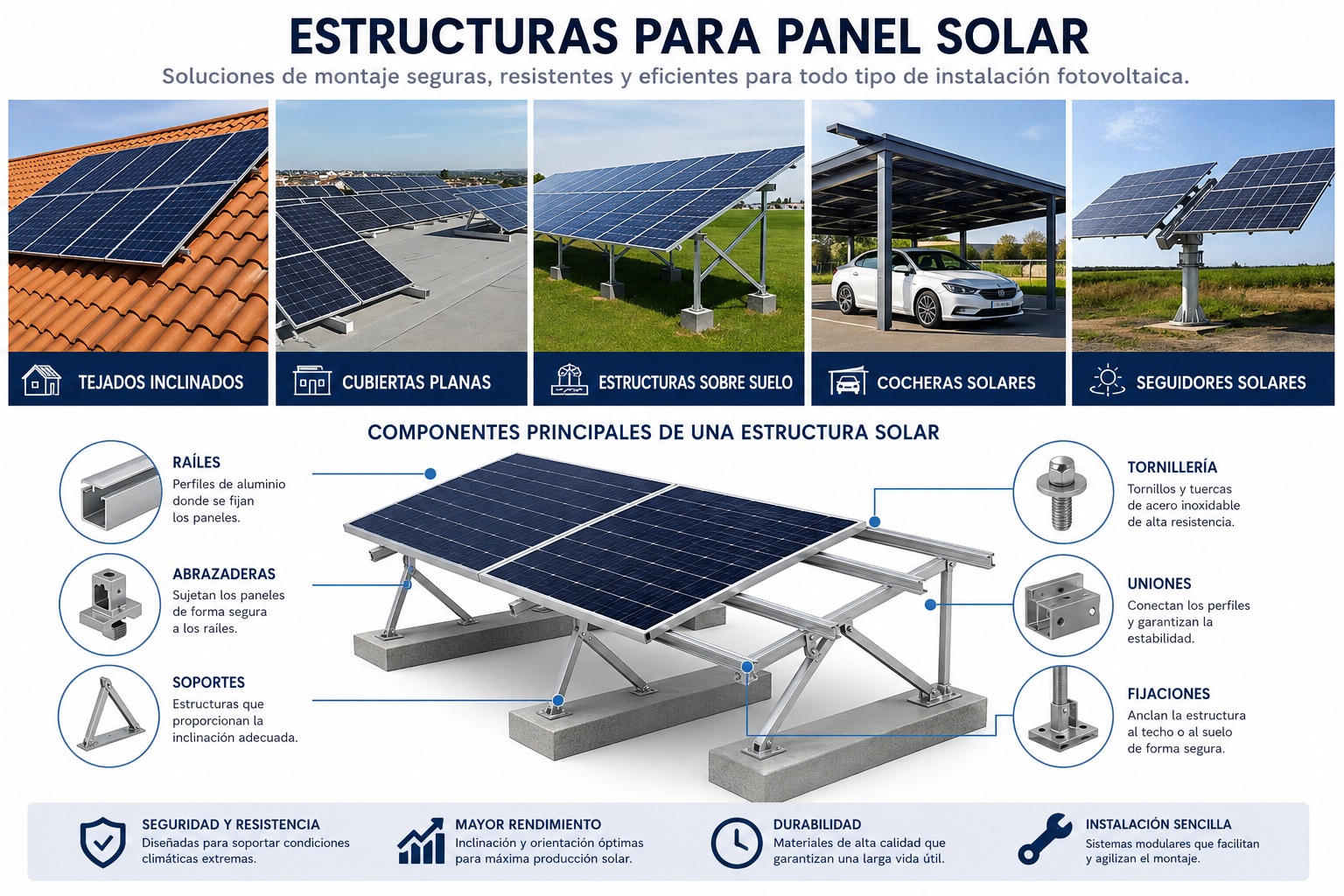
Types of Structures for Solar Panels
There are different mounting systems depending on where the panels will be installed.
Structures for Sloping Roofs
They are the most commonly used in homes.
They are fixed directly onto the roof using specific supports compatible with ceramic, metal or concrete tiles.
Advantages
- They make use of the existing space.
- Relatively quick installation.
- Less visual impact.
- Lower cost.
Structures for Flat Roofs
Industrial and commercial roofs often require inclined structures that allow the panels to be oriented correctly.
In many cases, ballasted systems are used that do not require drilling into the roof.
Benefits
- Flexible installation.
- Lower risk of leaks.
- Easy maintenance.
- Excellent for commercial buildings.
Structures Above Ground
When sufficient land is available, the panels can be installed directly onto metal structures anchored to the ground.
This system is common in solar plants and large photovoltaic projects.
Advantages
- Optimal orientation.
- Easy access.
- Possibility of expansion.
- Greater generation capacity.
Solar Structures for Garages
Solar canopies allow you to protect vehicles while generating electricity.
They are becoming increasingly common in businesses, shopping centers, and homes.
Its benefits include:
- Clean energy production.
- Protection against rain and sun.
- Efficient use of space.
Solar Tracking Structures
Solar trackers automatically adjust the position of the panels throughout the day.
There are systems:
- Single-axis.
- Two-axle.
Aunque requieren una inversión mayor, pueden incrementar significativamente la producción energética dependiendo de la ubicación geográfica y las condiciones del proyecto.
Materiales Utilizados en las Estructuras para Panel Solar
La elección del material influye directamente en la durabilidad del sistema.
Aluminio
Es uno de los materiales más utilizados debido a su ligereza y resistencia a la corrosión.
Ventajas
- Poco peso.
- Fácil instalación.
- Excelente resistencia al óxido.
- Bajo mantenimiento.
Acero Galvanizado
Se emplea especialmente en instalaciones de gran tamaño.
Entre sus características destacan:
- Alta resistencia mecánica.
- Gran capacidad de carga.
- Excelente estabilidad.
- Larga vida útil.
Acero Inoxidable
Generalmente se utiliza para tornillería y componentes expuestos a ambientes marinos o altamente corrosivos.
Ofrece una resistencia excepcional frente a la humedad y la oxidación.
Factores para Elegir la Mejor Estructura
Antes de seleccionar un sistema de montaje conviene analizar diversos aspectos.
Tipo de superficie
No es lo mismo instalar paneles sobre una cubierta inclinada que sobre un terreno abierto.
Cada superficie requiere fijaciones específicas.
Condiciones climáticas
Las estructuras deben diseñarse teniendo en cuenta:
- Velocidad del viento.
- Carga de nieve.
- Humedad.
- Temperaturas extremas.
- Riesgo sísmico según la región.
Orientación e inclinación
La inclinación correcta mejora considerablemente el rendimiento de los módulos solares.
En muchos casos se busca orientar los paneles hacia el ecuador para maximizar la captación solar, aunque la configuración ideal depende de la ubicación geográfica y del perfil de consumo.
Capacidad de carga
Es imprescindible verificar que el techo pueda soportar el peso adicional del sistema fotovoltaico.
En proyectos de gran tamaño puede ser necesario realizar un estudio estructural previo.
Compatibilidad con los Paneles
No todas las estructuras son compatibles con cualquier módulo fotovoltaico.
Es importante comprobar:
- Dimensiones.
- Espesor del marco.
- Sistema de fijación.
- Peso del panel.
Ventajas de Utilizar Estructuras de Alta Calidad
Elegir componentes certificados ofrece importantes beneficios a largo plazo.
Entre ellos destacan:
- Mayor seguridad.
- Menor mantenimiento.
- Mejor rendimiento energético.
- Instalación más sencilla.
- Menor riesgo de corrosión.
- Garantías más amplias.
- Mayor vida útil del sistema.
Aunque inicialmente puedan tener un coste superior, normalmente representan una inversión más rentable durante la vida útil del proyecto.
Instalación de Estructuras para Panel Solar
Una instalación profesional sigue una serie de etapas fundamentales.
Evaluación del lugar
Se analiza la orientación, sombras, resistencia estructural y espacio disponible.
Diseño del sistema
Se determina:
- Número de paneles.
- Distribución.
- Inclinación.
- Separación entre módulos.
- Sistema de fijación.
Montaje de la estructura
Los soportes se instalan respetando las especificaciones técnicas del fabricante.
Cada tornillo debe aplicarse con el par de apriete recomendado.
Colocación de los paneles
Los módulos se fijan mediante abrazaderas finales e intermedias que aseguran una sujeción firme sin dañar los marcos.
Inspección final
Se revisa toda la instalación para verificar la estabilidad mecánica y la correcta alineación de los paneles.
Mantenimiento de las Estructuras
Aunque requieren poco mantenimiento, es recomendable realizar inspecciones periódicas.
Se aconseja revisar:
- Tornillos.
- Anclajes.
- Corrosión.
- Deformaciones.
- Sellados.
- Elementos de fijación.
También es conveniente limpiar los paneles para evitar pérdidas de rendimiento provocadas por polvo, hojas o suciedad acumulada.
Errores Comunes al Elegir una Estructura
Muchas instalaciones presentan problemas debido a decisiones incorrectas durante la fase de diseño.
Entre los errores más frecuentes se encuentran:
- Comprar estructuras de baja calidad.
- Ignorar las cargas de viento.
- No considerar la resistencia del techo.
- Elegir materiales inadecuados para zonas costeras.
- Instalar una inclinación incorrecta.
- No respetar las recomendaciones del fabricante.
- Descuidar el mantenimiento preventivo.
Evitar estos errores mejora tanto la seguridad como la eficiencia del sistema fotovoltaico.
Innovaciones en Estructuras para Paneles Solares
El sector evoluciona constantemente para ofrecer soluciones más eficientes.
Algunas tendencias incluyen:
- Sistemas premontados para reducir tiempos de instalación.
- Estructuras ultraligeras para cubiertas con limitaciones de carga.
- Materiales con mayor resistencia a la corrosión.
- Diseños aerodinámicos para zonas con fuertes vientos.
- Sistemas modulares que facilitan futuras ampliaciones.
- Integración con tecnologías de seguimiento solar.
Estas innovaciones ayudan a optimizar tanto el rendimiento energético como los costes de instalación y mantenimiento.
Cómo Maximizar el Rendimiento de una Instalación Solar
Una estructura bien diseñada es solo una parte del éxito de un sistema fotovoltaico. Para obtener el máximo rendimiento también conviene:
- Evitar sombras permanentes sobre los paneles.
- Utilizar componentes certificados y compatibles.
- Realizar inspecciones periódicas.
- Mantener limpios los módulos.
- Verificar el estado de los anclajes y fijaciones.
- Contar con instaladores cualificados que sigan las normativas vigentes.
La combinación de una estructura resistente y un diseño adecuado permite mejorar la producción de energía y reducir los costes de mantenimiento a largo plazo.
Preguntas Frecuentes
¿Cuál es el mejor material para una estructura de panel solar?
El aluminio destaca por su resistencia a la corrosión y facilidad de instalación, mientras que el acero galvanizado ofrece una mayor capacidad de carga para proyectos de gran tamaño. La mejor elección dependerá del tipo de instalación y de las condiciones ambientales.
¿Cuánto dura una estructura para paneles solares?
Las estructuras fabricadas con materiales de alta calidad y correctamente mantenidas pueden superar los 25 años de vida útil, acompañando el ciclo de vida de la mayoría de los paneles solares.
¿Se pueden instalar paneles solares en cualquier techo?
Not always. It is necessary to assess the roof’s strength, orientation, slope, and the presence of shadows before installation.
Do the structures require maintenance?
Yes, although it’s minimal. It’s recommended to periodically inspect screws, anchors, and any signs of corrosion to ensure the safety and proper functioning of the system.
What type of structure is best for a home?
In most homes, structures for pitched roofs or flat roofs are the most practical and cost-effective options, provided they are suitable for the type of roof and the conditions of the site.
Conclusion
Solar panel mounting structures are an essential component of any photovoltaic installation. Their function goes far beyond simply supporting the panels: they ensure system stability, improve energy efficiency, and contribute to extending the lifespan of the entire installation.
Choosing the right type of structure, using durable materials like aluminum or galvanized steel, and having it professionally installed are crucial for a safe, long-lasting, and cost-effective system. Careful planning and regular maintenance will allow you to maximize your solar energy investment for many years to come.