Introduction
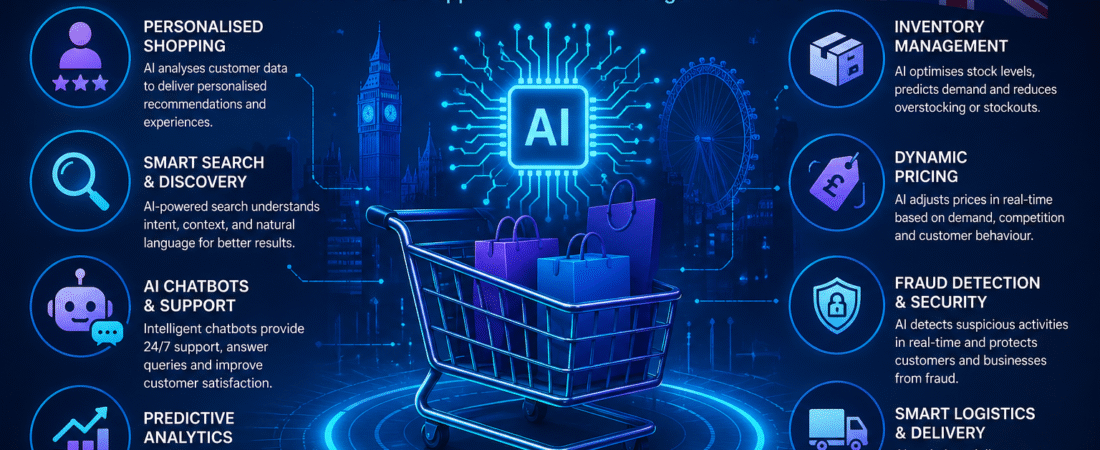
Artificial Intelligence (AI) is no longer a futuristic concept—it has become the backbone of modern eCommerce. In the UK, where online retail continues to expand rapidly, AI is playing a critical role in shaping how businesses operate, engage customers, and drive revenue. By 2026, AI is not just a competitive advantage—it is a necessity. From personalized shopping experiences to automated supply chains, UK eCommerce businesses are leveraging AI to stay ahead in an increasingly data-driven market. This article explores how AI is transforming the eCommerce landscape in the UK, the technologies driving this shift, and how businesses can adopt AI effectively to scale and succeed.
The Rise of AI in UK eCommerce
The UK is one of the most advanced eCommerce markets globally, with millions of consumers shopping online daily. As customer expectations evolve, businesses are under pressure to deliver faster, smarter, and more personalised experiences.
AI enables this transformation by:
- Processing vast amounts of customer data
- Automating repetitive tasks
- Delivering predictive insights
- Enhancing decision-making in real time
In 2026, AI adoption is no longer limited to large corporations—small and medium-sized enterprises (SMEs) are increasingly integrating AI tools into their operations.
Personalization at Scale
AI-Driven Customer Experience
One of the most significant contributions of AI in eCommerce is hyper-personalization. Customers expect tailored experiences, and AI makes this possible at scale.
AI analyses:
- Browsing behavior
- Purchase history
- Search patterns
- Demographic data
This allows businesses to:
- Recommend products in real time
- Personalise homepages
- Send targeted email campaigns
Impact on Conversion Rates
Personalisation directly impacts:
- Customer engagement
- Conversion rates
- Average order value
UK retailers using AI-driven personalization have seen measurable increases in sales and customer retention.
AI-Powered Product Recommendations
Recommendation engines are a cornerstone of modern eCommerce.
How They Work
AI algorithms use machine learning models to:
- Identify patterns in user behaviour
- Predict customer preferences
- Suggest relevant products
Benefits
- Increased cross-selling and upselling
- Improved customer satisfaction
- Reduced decision fatigue
By 2026, recommendation systems are more advanced, incorporating:
- Real-time intent signals
- Contextual data (location, time, device)
- Predictive analytics
Intelligent Search and Voice Commerce
Smart Search Capabilities
Traditional search functions are being replaced by AI-powered search engines that understand:
- Natural language queries
- Misspellings and synonyms
- User intent
This improves:
- Search accuracy
- Product discovery
- User experience
Voice Commerce Growth
With the rise of voice assistants, UK consumers are increasingly using voice search to shop online.
AI enables:
- Voice recognition
- Conversational interfaces
- Seamless ordering experiences
Voice commerce is expected to grow significantly in the UK by 2026, particularly for repeat purchases.
Chatbots and Virtual Assistants
24/7 Customer Support
AI-powered chatbots provide instant customer support, reducing the need for human intervention.
They can:
- Answer FAQs
- Track orders
- Process returns
- Assist with product selection
Enhancing Customer Satisfaction
Chatbots improve:
- Response times
- Customer satisfaction
- Operational efficiency
Advanced AI assistants in 2026 can handle complex queries, making them a vital tool for UK eCommerce businesses.
AI in Inventory Management
Demand Forecasting
AI helps businesses predict demand with high accuracy by analysing:
- Historical sales data
- Seasonal trends
- Market conditions
Stock Optimisation
Benefits include:
- Reduced overstocking
- Prevention of stockouts
- Improved cash flow management
In the UK’s competitive retail environment, efficient inventory management is critical for profitability.
Dynamic Pricing Strategies
Real-Time Price Optimisation
AI enables dynamic pricing by adjusting prices based on:
- Demand fluctuations
- Competitor pricing
- Customer behaviour
- Market trends
Competitive Advantage
Businesses can:
- Maximise profits
- Stay competitive
- Respond instantly to market changes
Dynamic pricing is widely used in sectors like fashion, electronics, and travel in the UK.
Fraud Detection and Security
AI for Risk Management
Online fraud is a major concern in eCommerce. AI helps detect and prevent fraudulent activities by:
- Monitoring transaction patterns
- Identifying anomalies
- Flagging suspicious behaviour in real time
Benefits
- Reduced financial losses
- Increased customer trust
- Enhanced compliance with UK regulations
By 2026, AI-driven fraud detection systems are highly sophisticated and essential for secure online transactions.
AI in Logistics and Supply Chain
Route Optimisation
AI improves delivery efficiency by:
- Optimising delivery routes
- Reducing fuel consumption
- Minimising delays
Warehouse Automation
AI-powered robots and systems:
- Manage inventory
- Process orders
- Improve fulfilment speed
In the UK, where fast delivery is a key customer expectation, AI-driven logistics provides a significant advantage.
Visual Search and Image Recognition
Shopping Through Images
AI enables customers to search for products using images instead of text.
For example:
- Uploading a photo of clothing to find similar items
- Scanning products for instant purchase options
Benefits
- Improved product discovery
- Enhanced user experience
- Increased engagement
Visual search is becoming a standard feature in UK eCommerce platforms by 2026.
AI-Generated Content and Marketing
Automated Content Creation
AI tools can generate:
- Product descriptions
- Blog posts
- Ad copy
- Email campaigns
SEO and Performance Marketing
AI helps optimise:
- Keywords
- Content structure
- User engagement
This allows businesses to scale their marketing efforts efficiently while maintaining quality.
Predictive Analytics for Business Growth
Data-Driven Decisions
AI uses predictive analytics to:
- Forecast sales
- Identify trends
- Understand customer behaviour
Strategic Planning
Businesses can:
- Make informed decisions
- Reduce risks
- Identify new opportunities
In 2026, predictive analytics is a core component of successful eCommerce strategies in the UK.
Challenges of AI Adoption in eCommerce
While AI offers numerous benefits, there are challenges:
1. High Initial Investment
Implementing AI systems can be costly, especially for small businesses.
2. Data Privacy Concerns
UK regulations require strict handling of customer data.
3. Integration Complexity
Integrating AI with existing systems can be technically challenging.
4. Skills Gap
There is a growing demand for AI expertise in the workforce.
Future Trends of AI in UK eCommerce
Looking ahead, AI will continue to evolve with new innovations:
1. Hyper-Automation
End-to-end automation of business processes.
2. Augmented Reality (AR) Integration
AI-powered AR for virtual try-ons and immersive shopping experiences.
3. Ethical AI
Focus on transparency, fairness, and data protection.
4. AI-Powered Marketplaces
Smarter platforms that connect buyers and sellers efficiently.
How UK Businesses Can Adopt AI Successfully
Start Small
Begin with simple AI tools like chatbots or recommendation engines.
Focus on Data Quality
Ensure accurate and clean data for better AI performance.
Invest in Training
Upskill teams to work effectively with AI technologies.
Choose the Right Tools
Select AI solutions that align with business goals.
Monitor and Optimize
Continuously analyse performance and improve AI systems.
Conclusion
AI is revolutionizing eCommerce in the UK, transforming how businesses operate and interact with customers. By 2026, AI is not just enhancing efficiency—it is redefining the entire shopping experience.
From personalized recommendations to intelligent logistics, AI empowers businesses to deliver faster, smarter, and more engaging services. While challenges exist, the benefits far outweigh the risks for those willing to adopt and adapt.
For UK eCommerce businesses, the message is clear: embracing AI is no longer optional—it is essential for survival and growth in a highly competitive digital marketplace.