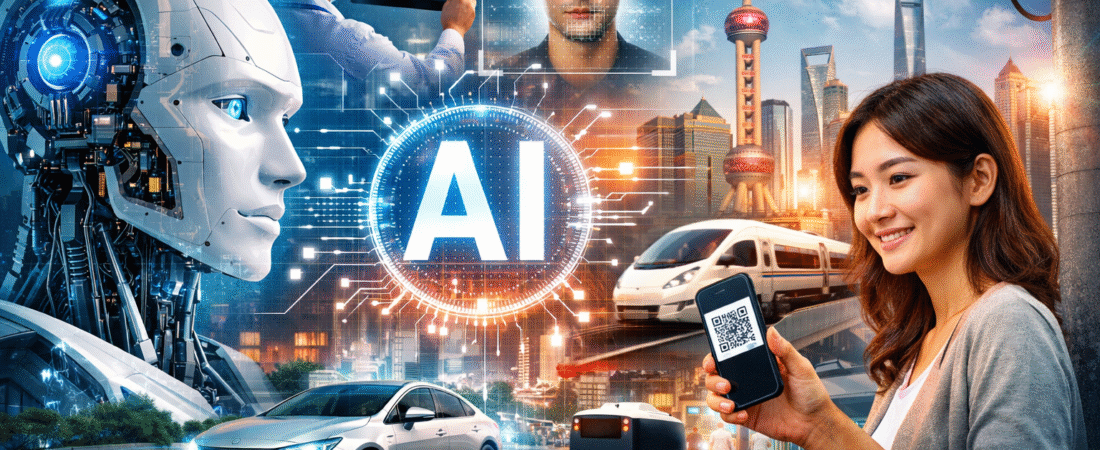
Artificial Intelligence (AI) is rapidly reshaping economies, industries, and lifestyles around the world. However, few countries are integrating AI into everyday life as extensively and rapidly as China. From smart cities and autonomous transportation to healthcare diagnostics and AI-powered commerce, China is leading a technological transformation that is redefining how people live, work, and interact with technology. This article explores how AI is changing daily life in China, the technologies behind this transformation, and what the future might hold for one of the world’s most technologically ambitious nations.
The Rise of Artificial Intelligence in China
Over the past decade, China has made AI development a national priority. Through government initiatives, massive data resources, and rapid technological innovation, the country has created one of the most advanced AI ecosystems globally.
In 2017, the Chinese government launched the New Generation Artificial Intelligence Development Plan, aiming to make China the world leader in AI by 2030.
Major technology companies such as Baidu, Alibaba, Tencent, and Huawei have invested billions into AI research and development.
These investments have accelerated AI adoption across various sectors, including healthcare, transportation, education, retail, and public safety.
AI-Powered Smart Cities in China
Smart Infrastructure and Urban Management
China is rapidly developing AI-powered smart cities designed to optimize urban life. Cities like Hangzhou, Shenzhen, and Beijing are integrating AI into transportation systems, traffic management, energy grids, and public safety networks.
For example, the City Brain platform developed by Alibaba uses AI algorithms and real-time data to monitor traffic flow, reduce congestion, and respond to emergencies faster.
Key benefits of AI-driven smart cities include:
-
Reduced traffic congestion
-
Improved emergency response times
-
Energy-efficient infrastructure
-
Better waste management systems
As a result, residents experience faster commutes, safer streets, and improved public services.
AI Surveillance and Public Safety
China has also implemented advanced AI surveillance systems to enhance public safety. Facial recognition technology allows authorities to monitor public spaces and identify individuals in real time.
Companies such as SenseTime and Megvii have developed powerful facial recognition systems capable of analyzing millions of faces within seconds.
These systems are widely used in:
-
Airports and train stations
-
Public transportation systems
-
Shopping malls
-
Urban streets
While these technologies improve security and crime prevention, they have also sparked global debates about privacy and data protection.
AI Revolution in Chinese Healthcare
AI-Assisted Medical Diagnosis
China’s healthcare system is increasingly adopting AI to improve medical diagnostics and patient care. AI systems can analyze medical images such as CT scans, MRIs, and X-rays faster and sometimes more accurately than human doctors.
Platforms developed by companies like Ping An Good Doctor use AI to assist doctors in diagnosing diseases and recommending treatment options.
Benefits of AI in healthcare include:
-
Faster disease detection
-
Reduced workload for doctors
-
Improved patient outcomes
-
Better healthcare accessibility in rural areas
In remote regions of China where doctors are scarce, AI-powered medical platforms allow patients to receive virtual consultations and AI-assisted diagnostics.
AI and Pandemic Response
During the COVID-19 pandemic, China utilized AI technologies to track outbreaks, analyze infection patterns, and accelerate vaccine research.
AI tools were used to:
-
Detect early symptoms through medical imaging
-
Monitor population movement
-
Track potential virus transmission
-
Support contact tracing systems
This demonstrated how AI could play a critical role in managing large-scale public health crises.
AI-Driven E-Commerce and Retail
Smart Shopping Experiences
China is home to one of the world’s most advanced e-commerce ecosystems. AI plays a central role in powering recommendation engines, logistics systems, and personalized shopping experiences.
Major platforms such as JD.com and Alibaba use AI to analyze consumer behavior and predict purchasing patterns.
AI technologies enable:
-
Personalized product recommendations
-
AI-powered customer service chatbots
-
Smart inventory management
-
Automated logistics networks
These innovations allow Chinese consumers to enjoy faster deliveries, often within hours of placing an order.
Cashless Society and AI Payments
China is also one of the world’s most advanced cashless economies. Mobile payment platforms such as Alipay and WeChat Pay use AI algorithms to detect fraud, manage financial transactions, and personalize financial services.
AI-driven financial technologies have transformed how people:
-
Pay for groceries
-
Transfer money
-
Apply for loans
-
Manage investments
Today, even street vendors and taxi drivers in China commonly accept mobile payments.
AI and Autonomous Transportation
Self-Driving Vehicles
China is heavily investing in autonomous transportation technologies. Companies such as Baidu are developing self-driving systems like Apollo, which powers robotaxis and autonomous buses.
Cities including Wuhan and Chongqing have begun testing robotaxi services where passengers can ride in self-driving vehicles without a human driver.
Benefits of AI-powered transportation include:
-
Reduced traffic accidents
-
Lower transportation costs
-
Increased mobility for elderly and disabled individuals
-
More efficient urban mobility
AI Traffic Management Systems
AI algorithms analyze real-time traffic data from cameras and sensors to optimize traffic signals and reduce congestion.
In cities like Hangzhou, AI systems have reduced traffic delays by up to 15–20%, demonstrating the power of AI in urban planning and transportation management.
AI in Education and Learning
Smart Classrooms and Personalized Education
China is also integrating AI into its education system. Smart classrooms equipped with AI technologies can track student engagement, analyze learning patterns, and personalize lessons.
AI education platforms can:
-
Adapt lessons based on student performance
-
Identify learning weaknesses
-
Provide customized study plans
-
Assist teachers in evaluating student progress
This data-driven approach helps students learn more efficiently and improves overall educational outcomes.
AI in Manufacturing and Industry
The Rise of Smart Factories
China’s manufacturing sector is undergoing a major transformation through AI and automation. Smart factories use AI-powered robots, predictive maintenance systems, and automated quality control.
Industrial companies such as Foxconn are increasingly deploying AI-driven robots to perform complex manufacturing tasks.
Advantages of AI-powered manufacturing include:
-
Higher production efficiency
-
Reduced operational costs
-
Improved product quality
-
Lower workplace accidents
China’s push toward Industry 4.0 is helping maintain its position as the world’s manufacturing powerhouse.
Ethical Challenges and Privacy Concerns
Despite its many benefits, the rapid expansion of AI in China raises important ethical and social concerns.
Data Privacy
AI systems rely heavily on massive amounts of personal data. Critics argue that extensive data collection may threaten individual privacy.
Job Displacement
Automation and AI-driven robotics could replace certain types of jobs, particularly in manufacturing and logistics sectors.
Surveillance Concerns
AI-powered surveillance systems have raised global debates about the balance between public safety and civil liberties.
Addressing these challenges will be critical as China continues expanding AI technologies across society.
The Future of AI in China
China’s commitment to AI innovation suggests that its influence on daily life will only continue to grow.
Emerging AI technologies being developed in China include:
-
AI-powered humanoid robots
-
Advanced natural language processing systems
-
AI-generated content tools
-
Smart healthcare monitoring systems
With continued investment and technological development, China is likely to remain a global leader in AI innovation.
Conclusion
Artificial Intelligence is transforming China into one of the most technologically advanced societies in the world. From smart cities and autonomous vehicles to AI healthcare systems and cashless payments, AI is deeply embedded in the daily lives of millions of Chinese citizens.
While challenges such as privacy concerns and job displacement remain, the benefits of AI-driven innovation are undeniable. As China continues investing heavily in artificial intelligence, the country is shaping a future where technology and daily life are more interconnected than ever before.
The evolution of AI in China not only reflects the country’s technological ambition but also offers a glimpse into how AI may transform societies around the world in the coming decades.